Reference Manual on Scientific Evidence: Fourth Edition (2025)
Chapter: Reference Guide on Estimation of Economic Damages
Reference Guide on Estimation of Economic Damages
MARK A. ALLEN, CARLOS BRAIN, AND FILIPE LACERDA
Mark A. Allen, J.D., is Principal at Cornerstone Research.
Carlos Brain, M.B.A., Sc.M., is Vice President at Cornerstone Research.
Filipe Lacerda, Ph.D., M.B.A., Finance, is Vice President at Cornerstone Research.
The views expressed herein are solely those of the authors, who are responsible for the content, and do not necessarily represent the views of Cornerstone Research.
CONTENTS
Damages Experts’ Qualifications
The Standard General Approach to Quantification of Economic Damages
Isolating the Effect of the Harmful Act
General Categories of Damages Measures
Basic Issues Arising in Damages Estimation
Valuation Issues in the Analysis of Economic Damages
Issues Arising in Connection with the Use of the Market Price of the Product or Asset at Issue
Adjusting the market price of ostensibly similar products or assets
Issues Arising in Connection with the Use of Models to Simulate the But-For Price
Realistic modeling of preferences, incentives, and constraints of buyers and sellers
Modeling the impact of the alleged misconduct on demand and supply
Accounting for Market Frictions
Issues Arising in Connection with the Use of Repair or Abatement Costs
Estimating the Period-by-Period Direct Impact of the Alleged Harmful Act
Disputes about whether all economic consequences of the alleged harmful act are being accounted for
Disputes about the use of expected outcomes to estimate the impact of the alleged harmful act
Disputes about the economic situation in future periods
Disputes about the consideration of non-cash effects of the alleged harmful act
Valuing the Period-by-Period Impact of the Alleged Harmful Act as of a Single Valuation Date
Estimating the time value of money
Disagreements about what valuation date to use
Other Issues Arising in General in Damages Measurement
Criteria for Determining the Validity of Data
Quantitative Methods for Validation
Damages with Multiple Challenged Acts: Disaggregation
Disputes About Whether the Plaintiff Is Entitled to All the Damages
The Effect of a Liquidated Damages Clause
Damages of Individual Class Members
Damages as a Basis to Evaluate the Fairness of a Proposed Settlement
Damages Issues in Selected Types of Cases
Estimation of Economic Damages in Consumer Product Liability and Misrepresentation Cases
Defining the Plaintiff’s Economic Position in the Actual and But-For Worlds
Conjoint Analysis and Supply-Side Considerations
Estimation of Economic Damages in Securities Cases
Key Areas of Disagreement in the Economic Analysis of Inflation and Losses Caused
Analysis of “confounding” information
Measuring inflation at the time of purchase
Estimation of Economic Damages in Antitrust Cases
Quantifying Damages in an Antitrust Matter
Before-and-after model of overcharge damages
Difference-in-differences model of overcharge damages
Estimation of Economic Damages from Loss of Personal Income
Estimation of Losses Over a Person’s Lifetime
Calculation of Fringe Benefits
FIGURE
TABLE
Introduction
This reference guide identifies areas of dispute that arise when economic losses are at issue in legal proceedings. We focus on explaining the issues in these disputes rather than taking positions on their proper resolution. We discuss the application of economic analysis within established legal frameworks for damages, cover topics in economics that arise in measuring damages, and, where useful, provide citations to cases that illustrate the principles and techniques discussed in the text.
We begin with a brief discussion of qualifications for damages experts. We then set forth the standard general approach to quantification of economic damages, with particular focus on translating the legal theory of the harmful event into an analysis of the economic impact of that event and choosing the measure of economic damages. Next, we consider disputes that may arise between the parties regarding damages estimation. Such disputes may concern basic issues (e.g., proper damages measure and losses caused), valuation issues (e.g., damages arising on single or multiple dates, and the use of market or other data to estimate damages), other issues (e.g., data validity, prejudgment interest, disaggregation), and limitations on damages. We also discuss damages in class actions as well as the application of damages principles to specific types of cases.
We use brief examples to illustrate the disputes that can arise and provide intuition for relevant economic issues. These examples are not full case descriptions; they are deliberately stylized, attempting to capture the types of disagreements about damages that arise in practical experience, although they are purely hypothetical. In many examples, the dispute involves factual and economic as well as legal issues. We do not try to resolve the disputes in these examples; hopefully the examples will help clarify the legal and factual disputes that need to be resolved before or at trial.
Damages Experts’ Qualifications
Experts who quantify damages come from a variety of backgrounds. The expert should be trained and experienced in quantitative analysis. For economists, the common qualification is a Ph.D. degree. Damages experts with business or accounting backgrounds often have M.B.A. or other advanced degrees, or C.P.A. credentials. Both the method of damages estimation used and the substance of the damages claim dictate the specific areas of specialization the expert should have. In some cases, participation in original research and authorship of professional publications may add to the qualifications of an expert. However, relevant research and publications are not likely to be on the topic of damages measurement per se, but rather on topics and methods encountered in damages analysis.
Professional training and experience in areas relevant to the substance of the damages claim may be required. For example, in antitrust, a background in industrial organization (i.e., competition economics) may be helpful; in securities damages, a background in finance may assist the expert; and in the case of lost earnings, an expert may benefit from training in labor economics.
An analysis by even the most qualified expert may face a motion to exclude under Federal Rule of Evidence 702 as interpreted by the Daubert line of cases.1 Under Rule 702, an expert witness who is “qualified . . . by knowledge, skill, experience, training, or education,” is allowed to testify when
(a) the expert’s scientific, technical, or other specialized knowledge will help the trier of fact to understand the evidence or to determine a fact in issue; (b) the testimony is based on sufficient facts or data; (c) the testimony is the product of reliable principles and methods; and (d) the expert has reliably applied the principles and methods to the facts of the case.
These criteria, which are intended to exclude testimony that is irrelevant or is based on untested and unreliable theories, are often applied to damages analyses. Examples include the following:
- A proposed damages expert may be qualified generally to opine on damages issues but may lack the qualifications necessary to offer an opinion in the context of the particular matter at hand. For example, a labor economist may lack the proper education, training, and experience to opine on damages in a securities matter.
- A proposed expert may have used a methodology that is incorrect as a matter of economics; the results may have been based on insufficient data (e.g., too few observations); or a theoretically sound analysis may not have been properly applied, even if large amounts of data were used in the analysis.
- All or part of a damages analysis may no longer be relevant if certain legal claims have been dismissed, or expert opinion on damages simply may not be needed at all, such as where damages may be determined using a simple mathematical formula.
Even if a motion to exclude fails, it can be an effective way for a party to probe an opposing expert’s damages analysis prior to trial. For this reason, among others, motions to exclude proposed expert damages testimony have become relatively commonplace.
1. Daubert v. Merrell Dow Pharms., Inc., 509 U.S. 579 (1993); Kumho Tire Co. v. Carmichael, 526 U.S. 137 (1999). For a discussion of emerging standards of scientific evidence, see Liesa L. Richter & Daniel J. Capra, The Admissibility of Expert Testimony, in this manual.
The Standard General Approach to Quantification of Economic Damages
In this section, we review the general principles of the standard approach to the estimation of economic damages and basic issues that arise in such estimation. For each principle, there are several areas of potential dispute. The sequence of issues discussed here is intended to identify most of the areas of disagreement between the damages analyses of opposing parties with respect to these principles.
General Principles
We begin by setting forth the standard general approach to damages quantification, with particular focus on defining the harmful event and the alternative, or but-for, scenario. In most cases, the goal of measurement of economic damages is to estimate the plaintiff’s loss of economic value caused by the defendant’s harmful act. The loss of value may arise from a single event, such as overpayment for a consumer product, or it may take the form of a reduced stream of profits or earnings over time. The losses are net of any costs avoided because of the harmful act.
In principle, then, economic damages are the difference between (1) the plaintiff’s economic position assuming that the alleged harmful act had not occurred, and (2) the plaintiff’s actual economic position as a result of the harmful act.2 The former considers the plaintiff’s economic position absent any past and future effects of the harmful act. We refer to this as the plaintiff’s but-for economic position in the but-for world. The latter considers the plaintiff’s actual economic position given the occurrence of the harmful act. We refer to this as the plaintiff’s actual economic position in the actual world.
Figure 1 illustrates the structure of the standard damages study. We begin by estimating the plaintiff’s losses as of the appropriate valuation date. The appropriate valuation date may vary depending on the nature of the loss and the plaintiff’s theory of recovery (e.g., breach of contract, tort, fraud, etc.). Losses are the difference between the plaintiff’s but-for economic position and the plaintiff’s actual economic position as of the valuation date. Note that the plaintiff’s but-for economic position may require estimating past losses as well as future losses, again
2. Damages are sometimes measured based on the defendant’s gain rather than the plaintiff’s losses. If measured based on the defendant’s gain, economic damages are the difference between (1) the defendant’s actual economic position as a result of the harmful act, and (2) the defendant’s economic position assuming that the alleged harmful act had not occurred.
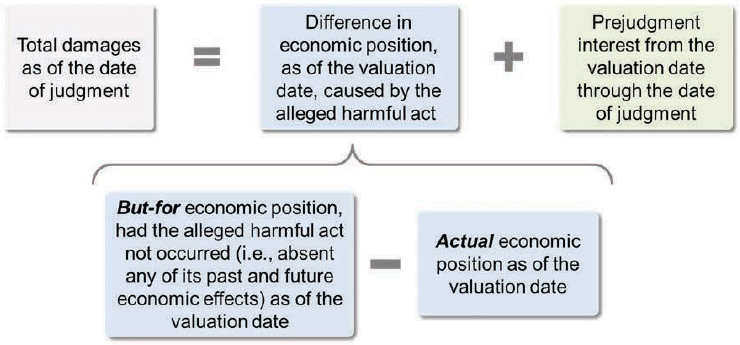
determining their value as of the valuation date. The plaintiff may be entitled to prejudgment interest through the judgment date on their damages as of the valuation date.3
Isolating the Effect of the Harmful Act
The first step in a damages study is the translation of the legal theory of the harmful event into an analysis of the economic impact of that event. As noted above, in most cases, the analysis considers the difference between what the plaintiff’s economic position would have been if the harmful event had not occurred and the plaintiff’s actual economic position as of the valuation date.
The characterization of the harmful event begins with a clear statement of what occurred in the actual world. This characterization also will include a description of the but-for world, including the defendant’s proper actions in place of their unlawful actions and a statement about the economic situation of all relevant parties absent the wrongdoing, with the defendant’s proper actions replacing the unlawful ones. Damages measurement then determines the plaintiff’s hypothetical economic position in the but-for world. Economic damages are the difference between that value and the actual value that the plaintiff achieved.
3. The plaintiff may also be due postjudgment interest, which is interest on the damages award from the date of judgment to the date the defendant satisfies the judgment.
Because the but-for world differs from what actually happened only with respect to the harmful act and its reasonably foreseeable economic consequences, damages measured in this way isolate the change in the plaintiff’s economic position caused by the harmful act and exclude any change in the plaintiff’s economic position arising from other causes.4 Thus, a proper construction of the but-for world and measurement of the plaintiff’s economic position in the but-for world by definition include in damages only the loss caused by the harmful act.
Properly translating the legal theory of the harmful act into an analysis of the economic impact of that event is a fundamental step in the estimation of economic damages. Failure to do so may result in the damages analysis being discounted or excluded altogether. For example, in Comcast Corp. v. Behrend, the U.S. Supreme Court found that the plaintiffs’ expert had put forth a damages model that “failed to measure damages resulting from the particular antitrust injury on which . . . liability in this action is premised.”5 Citing the discussion in the prior edition of this reference guide, the Court determined that the expert’s “methodology . . . identifies damages that are not the result of the wrong” and measures damages “caused by factors unrelated to an accepted theory of . . . harm.”6
4. Reasonable foreseeability is a legal doctrine that courts use to determine whether the consequences of a legal or contractual breach are too remote to be borne by the defendant. Reasonable foreseeability is not a measure of damages, but rather an upper limit on damages. The use of “reasonable” here relates to the legal concept of the “reasonable person” or “economic person,” and concerns actions that a reasonable person or economically rational actor under similar circumstances would take. See, e.g., Richard A. Posner, Economic Analysis of Law (2d ed. 1977); Steven Shavell, Foundations of Economic Analysis of Law (2004); Israel Gilead & Michael D. Green, Positive Externalities and the Economics of Proximate Cause, 74 Wash. & Lee L. Rev. 1517 (2017); John Fabian Witt & Morgan Savige, Foreseeability Conventions, 44 Cardozo L. Rev. 1075 (2023); Russ VerSteeg, Perspectives on Forseeability in the Law of Contracts and Torts: The Relationship Between “Intervening Causes” and “Impossibility,” 2011 Mich. St. L. Rev. 1497 (2011). Reasonable foreseeability is not a term of art in the field of economics. While determinations regarding reasonable foreseeability may impact the damages analysis, application of the concept is not within the purview of the damages expert. As such, the damages expert may require assumptions from counsel as to whether a particular outcome is a reasonably foreseeable consequence of the alleged harmful act.
5. Comcast Corp. v. Behrend, 569 U.S. 27, 46 (2013).
6. Id. at 38 (“‘The first step in a damages study is the translation of the legal theory of the harmful event into an analysis of the economic impact of that event.’ The district court and the court of appeals ignored that first step entirely” (citations omitted)). See also In re POM Wonderful LLC, No. ML 10–02199 DDP RZX, 2014 WL 1225184, at *5 (C.D. Cal. March 24, 2014) (damages expert “made no attempt, let alone an attempt based upon sound methodology, to explain how Defendant’s alleged misrepresentations caused any amount of damages”); In re Domestic Drywall Antitrust Litig., No. 13-MD-2437, 2017 WL 3700999, at *14 (E.D. Pa. Aug. 24, 2017) (expert’s damages model was “riddled with assumptions that divorce the model from the facts”).
General Categories of Damages Measures
In most cases, damages are measured based on one or more of the following six categories: (1) expectation, (2) reliance, (3) restitution, (4) statutory, (5) liquidated, and (6) punitive.7 We discuss each of these in turn.
- Expectation: Plaintiff restored to the same financial position as if the defendant had performed as promised.
Expectation damages typically apply to breach-of-contract claims, where the wrongdoing is the failure to perform as promised and the but-for scenario hypothesizes the absence of that wrongdoing—that is, proper performance by the defendant. Expectation damages are an amount sufficient to place the plaintiff in the same economic position as if the defendant had fulfilled the promise or bargain.8
- Reliance: Plaintiff restored to the same position as if the relationship with the defendant or the defendant’s misrepresentation (and resulting harm) had not existed in the first place.
Reliance damages generally apply to torts and to some breach-of-contract claims. Such damages restore the plaintiff to the same financial position they would have enjoyed absent the defendant’s conduct.9 Reliance most often includes out-of-pocket costs,10 but may also include compensation for lost opportunities when appropriate.11 In such cases, reliance damages may approach expectation
7. The law imposes several limitations on damages, which are discussed below in the section titled “Limitations on Damages.”
8. See John R. Trentacosta, Damages in Breach of Contract Cases, 76 Mich. Bus. J. 1068, 1068 (1997) (describing expectation damages as damages that place the injured party in the same position as if the breaching party completely performed the contract); Spring Creek Expl. & Prod. v. Hess Bakken Inv., 887 F.3d 1003, 1026 (10th Cir. 2018) (defining expectation damages as the amount of damages necessary to place the injured party in the same position it would have occupied had the breach not occurred). See also Restatement (Second) of Contracts § 344(a) (1981).
9. See E. Allan Farnsworth, Legal Remedies for Breach of Contract, 70 Colum. L. Rev. 1145, 1148 (1979) (the objective of reliance damages is to put the promisee, or nonbreaching party, back into the position it would have been had the promise not been made). See also Restatement (Second) of Contracts § 344(b) (1981). Reliance damages include expenditures made in preparation for performance and performance itself. Restatement (Second) of Contracts § 349 (1981).
10. Out-of-pocket costs are expenses incurred by a party in preparing to perform (or in performing) a contract in reliance on the terms of the agreement. This is distinct from the notion of out-of-pocket damages used in securities fraud damages, which relates to the difference between price paid and a but-for price that would have been paid. See the discussion in the section titled “Estimation of Economic Damages in Securities Cases” below.
11. Compensation for lost opportunities embodies the economic concept of opportunity cost, which expresses the relationship between scarcity and choice. Given an economic actor facing a
damages.12 For a tort, the goal of reliance damages is to place the plaintiff in a position economically equivalent to their position absent the harmful act.13 For a breach of contract, measuring damages as the amount of compensation needed to return the plaintiff to the position they would have been in had the contract had not been made in the first place will result in refunding the part of the plaintiff’s reliance investment that cannot be recovered in other ways. Thus, reliance damages may be appropriate where the plaintiff made an investment relying on the defendant’s performance.
Example: Agent contracts with Owner for Agent to sell Owner’s farm. The asking price is $1,000,000, and the agreed fee is 6%. Agent incurs costs of $1,000 in listing the property. A potential buyer offers the asking price, but Owner withdraws the listing. Agent calculates (expectation) damages as $60,000, the agreed fee for selling the property. Owner calculates (reliance) damages as $1,000, the amount that Agent spent to advertise the property.
- Restitution: Plaintiff compensated by the amount of the defendant’s gain from the unlawful conduct, also called compensation for unjust enrichment, disgorgement of ill-gotten gains, or compensation for unbar-gained-for benefits.
Restitution damages are awarded to prevent the defendant’s unjust enrichment from the unlawful conduct. The goal of restitution damages is to restore the defendant to the economic position they would have been in had they not engaged in the wrongful act, and typically includes disgorgement of defendant’s
choice between mutually exclusive alternatives, the opportunity cost of the alternative selected (e.g., entering into a contract with vendor A) is the value of the best alternative not chosen (e.g., entering into a contract with vendor B, C, or D). See, e.g., N. Gregory Mankiw, Principles of Microeconomics 6 (8th ed. 2016) (“The opportunity cost of an item is what you give up to get that item.” (emphasis omitted)).
12. In some situations, reliance damages can exceed expectation damages, but the court may limit damages to the expectation measure. See, e.g., Fairholme Funds, Inc. v. Fed. Hous. Fin. Agency, No. 1:13-cv-1053-RCL, 2022 WL 11110584, at *4 (D.D.C. Oct. 19, 2022) (Plaintiff claimed reliance damages “many multiples higher” than the allowed measure of expectation damages. The court stated, “In contract cases, expectation damages are preferred, with reliance damages considered as an alternative or proxy if expectation damages are not readily ascertainable. . . . [P]laintiffs . . . cannot recover reliance damages so far in excess of ascertainable expectation damages that they would necessarily place those plaintiffs in a better position than they would have been in had the contract been performed.”).
13. See, e.g., East River Steamship Corp. v. Transamerica Delaval Inc., 476 U.S. 858, 873 n.9 (1986) (“tort damages generally compensate the plaintiff for loss and return him to the position he occupied before the injury”).
ill-gotten gains.14 In practice, restitution is often the same, from the perspective of quantification, as reliance damages. If the only loss to the plaintiff from the defendant’s harmful act arises from an expenditure that the plaintiff made that cannot otherwise be recovered, the plaintiff receives compensation equal to the amount of that expenditure.15
- Statutory: Plaintiff’s compensation is an amount established by statute, either as a set amount per occurrence of wrongdoing or determined using a statutory formula. For example, this measure of damages is often found in cases involving violations of state labor codes and in copyright infringement.
- Liquidated: Plaintiff compensated by an amount specified in a legal agreement or contract between the parties.
- Punitive: Compensation to reward the plaintiff for detecting and prosecuting the wrongdoing or to deter similar wrongdoing in the future.
A plaintiff cannot normally seek punitive damages in a claim for breach of contract but may seek them in addition to compensatory damages in connection with a tort claim.16 Although punitive damages are rarely the subject of expert testimony, economists have advanced the concept that punitive damages compensate a plaintiff who brings a case for a wrongdoing that is hard to detect or hard to prosecute.17
Basic Issues Arising in Damages Estimation
Losses Caused
The analysis of losses caused is typically a key part of the analysis of damages. Analyzing damages requires isolating the portion, if any, of the plaintiff’s losses that can be attributed to the harmful act from the portion that can be attributed to other factors.
14. Note the distinction between restitution and reliance damages. The objective of restitution damages is to put the promisor, or breaching party, back in the position in which it would have been had the promise not been made. In contrast, reliance damages seek to put the promisee, or nonbreaching party, back in the position in which it would have been if the promise had not been made. See E. Allan Farnsworth, Legal Remedies for Breach of Contract, 70 Colum. L. Rev. 1145, 1148 (1979). Both measures seek to restore the status quo ante. See also Restatement (Third) of Restitution and Unjust Enrichment (2011).
15. See Restatement (Second) of Contracts § 344(c) (1981).
16. Compensatory damages are damages “sufficient in amount to indemnify [or compensate] the injured person for the loss suffered.” Damages, Black’s Law Dictionary (11th ed. 2019).
17. See Steven Shavell, Foundations of Economic Analysis of Law 244 (2004).
Example: Worker who smokes is the victim of a disease caused either by exposure to xerxium or by smoking. Worker makes leather jackets tanned with xerxium. The disease precludes Worker from earning wages. Worker sues the producer of the xerxium, Xerxium Mine, and calculates damages as all lost wages. Defendant Xerxium Mine, in contrast, attributes most of the losses to smoking and calculates damages as only a fraction of lost wages.
Frequently, the defendant will calculate damages on the premise that the harmful act had no causal relationship to the plaintiff’s losses—that is, the plaintiff’s losses would have occurred irrespective of the harmful act. The defendant’s but-for scenario will thus describe a situation in which the losses happen anyway. This is equivalent to arguing that the harmful act occurred but the plaintiff suffered no incremental losses from it.
Example: Contractors conspired to rig bids in a construction deal. State seeks damages for subsequent higher prices. Contractors’ damages estimate is zero because they assert that the only effect of the bid rigging was to determine the winner of the contract and that prices were not affected.
In other situations, unexpected events occurring after the harmful event (known as subsequent unexpected events) can increase or decrease the plaintiff’s actual loss relative to what might have been expected at the time of the harmful event.
Example: Housepainter uses faulty paint, which begins to peel a month after the paint job. Owner measures damages as the cost of repainting. Painter disputes this measure on the ground that a hurricane that occurred three months after the paint job would have ruined a proper paint job anyway.
A plaintiff may argue that a harmful act has caused significant losses for many years. The defendant may respond that most of the losses that occurred from the injury are the result of causes other than the harmful act. Thus, the defendant may argue that the injury was caused by multiple factors, only one of which was the result of the harmful act, or that the plaintiff’s injury was caused by subsequent events.
Example: Real Estate Agent is wrongfully denied affiliation with Broker. Agent’s damages study projects past earnings into the future at the rate of growth of the previous three years. Broker’s study projects that earnings would have declined even without the breach because of a downturn in the real estate market.
Comment: The difference between a damages study based on extrapolation from the past, here used by Agent, and a study based on actual data after the harmful act, here used by Broker, is one of the most common sources of disagreement in damages. This is a factual dispute that hinges on Broker demonstrating that there is a relationship between real estate market conditions and the earnings of agents. The example also illustrates how subsequent unexpected events can affect damages calculations.
Hypothesizing Legitimate Conduct of the Defendant in Analyzing the Plaintiff’s Economic Position But For the Harmful Event
One party’s damages analysis may hypothesize the absence of any act of the defendant that influenced the plaintiff, whereas the other party’s damages analysis may hypothesize an alternative, legal act. This type of disagreement is particularly common in antitrust and intellectual property disputes. Although disagreement over the alternative scenario in a damages study is generally a legal question, opposing experts may have been given different legal guidance and therefore made different economic assumptions, resulting in major differences in their damages estimates.
Example: Defendant Copier Service’s long-term contracts with customers are found to be unlawful because they create a barrier to entry that maintains Copier Service’s monopoly power. Plaintiff Rival’s damages study hypothesizes no contracts between Copier Service and its customers, so Rival would face no contractual barrier to bidding those customers away from Copier Service. Copier Service’s damages study assumes medium-term contracts with its customers and argues that these would not have been found to be unlawful. Under Copier Service’s assumption, Rival would have been much less successful in bidding away Copier Service’s customers, and damages are correspondingly lower.
Comment: Assessment of damages will depend greatly on the substantive law governing the injury. The proper characterization of Copier Service’s alternative conduct usually is an economic issue. However, the expert must also have legal guidance as to the proper legal framework for damages. Counsel for the plaintiff may instruct the plaintiff’s damages expert to use a legal framework different from that used by counsel for the defendant.
Considering All the Differences in the Plaintiff’s Situation in the But-For Scenario Versus Assuming That Many Aspects Would Be the Same as in Actuality
The analysis of some types of harmful events requires consideration of effects that involve changes in the economic environment caused by the harmful event, such as price erosion.18 For a business, the main elements of the economic environment that may be affected by the harmful event include the prices charged by rivals, the demand facing the seller, and the prices of inputs. For example, misappropriation of intellectual property may cause lower prices because products produced with the misappropriated intellectual property compete with products sold by the owner of the intellectual property.19
In contrast, some types of harmful events do not change the plaintiff’s economic environment. The theft of a small amount of the plaintiff’s products would not change the market price of those products, nor would an injury to a worker change the general level of wages in the labor market. A damages study need not analyze changes in broader markets when the harmful act plainly has minuscule effects in those markets.
In situations where the plaintiff claims price erosion, the plaintiff may assert that absent the defendant’s wrongdoing, a higher price could have been charged and therefore that the defendant’s harmful act has eroded the market price. The defendant may reply that the higher price would lower the quantity sold. The parties may then dispute how much the quantity would fall as a result of higher prices.
Example: Valve Maker infringes Rival’s patent. Rival calculates lost profits as the profits Rival would have made, including a price-erosion effect. The amount of price erosion is the difference between the higher price that Rival would have been able to charge absent
18. See, e.g., Beijing Choice Elec. Tech. Co. v. Contec Med. Sys. USA Inc., No. 18 C 0825, 2020 WL 1701861, at *9 (N.D. Ill. Apr. 8, 2020) (“To prove lost profits damages, a patentee must reconstruct the market that ‘would have developed absent the infringing product,’ and the alleged infringer’s market share may be a relevant data point in this reconstruction. For instance, if an alleged infringer’s market share increases after it introduces the product accused of infringement, that may shed light on what the patentee’s market share would have been had there been no infringement. Or, if an alleged infringer’s market share does not change significantly after it introduces the accused product, that may indicate that lost profits damages are not appropriate because consumers do not care whether the product uses the patented features at issue” (citations omitted)).
19. See, e.g., Power Integrations, Inc. v. Fairchild Semiconductor Int’l, Inc., 711 F.3d 1348, 1382–83 (Fed. Cir. 2013) (“Lost revenue caused by a reduction in the market price of a patented good due to infringement is a legitimate element of compensatory damages. Indeed, an infringer’s activities do more than divert sales to the infringer. They also depress the price [of the patented product].”).
Valve Maker’s presence in the market and the actual price. The price-erosion effect is that price difference multiplied by the combined sales volume of Valve Maker and Rival. Defendant Valve Maker counters that the volume would have been lower had the price been higher, and measures damages using the lower volume.
In more complicated situations, the damages analysis may need to focus on how an entire industry would be affected by the absence of the defendant’s wrongdoing. For example, one federal appeals court held that a damages analysis for exclusionary conduct must consider that absent the defendant’s conduct, firms other than the plaintiff may have entered the market. Competition from such firms would have reduced prices, and as a result the plaintiff’s profits would have been lower than those posited in the plaintiff’s damages analysis.20
Example: Printer Maker has used unlawful means to exclude rival suppliers of computer printer ink cartridges. Rival calculates damages on the assumption that they would have been the only additional seller in the market absent the exclusionary conduct and that Rival would have been able to sell its cartridges at the same price actually charged by Printer Maker. Printer Maker counters that other sellers would have entered the market and driven the price down, and so Rival has overstated their damages.
Comment: Increased competition lowers prices in all but the most unusual situations. Again, determination of the number of entrants that may have been attracted to the market absent the exclusionary conduct, and analysis of their effect on prices, requires a full economic analysis of the industry.
A clear statement of the plaintiff’s situation but for the harmful event is helpful in avoiding double counting that can arise if a damages study confuses or combines reliance and expectation damages.
Example: Marketer is the victim of defective products made by Manufacturer; Marketer’s business fails as a result. Marketer’s damages
20. See Cave Consulting Grp., Inc. v. OptumInsight, Inc., No. 15-cv-03424-JCS, 2020 WL 127612, at *7 (N.D. Cal. Jan. 10, 2020) (no evidence provided that would provide the jury with any basis to disentangle “favorable aspects of an anticompetitive market such as an unnatural price differential between [plaintiff] and [its] competitors and limited competition from third parties because of the difficulty of entering the market.”). See also Sun Microsystems Inc. v. Hynix Semiconductor Inc., 608 F. Supp. 2d 1166 (N.D. Cal. 2009) (holding that a before-and-after damages analysis requires “some showing that the market conditions in the two periods were similar but for the impact of the violation”); Dolphin Tours, Inc. v. Pacifico Creative Serv., Inc., 773 F.2d 1506, 1512 (9th Cir. 1985).
study adds together the out-of-pocket costs of creating the business and the projected profits of the business had there been no defects. Manufacturer’s damages study measures the difference between the profits Marketer would have made absent the defects and the profits Marketer actually made.
Comment: Marketer has mistakenly added together damages from the reliance and expectation measures of damages. Under the reliance measure, Marketer is entitled to be put back to where they would have been had they not started the business in the first place. Damages would be total outlays less the revenues actually received. Under the expectation measure, Marketer is entitled to the extra profits they would have received had there been no product defects. Out-of-pocket expenses of starting the business would have no effect on expectation damages because they would be present in both the actual and but-for worlds and thus would offset each other.
Valuation Issues in the Analysis of Economic Damages
As discussed in the previous section, the analysis of economic damages compares a plaintiff’s economic position in the but-for world—that is, absent any past and future effects of the alleged harmful act on the plaintiff’s economic position—to that plaintiff’s economic position in the actual world, and quantifies the economic value of that difference as of a specific date (the valuation date).21 Because an analysis of economic damages is, by definition, a valuation exercise, it typically requires that economic experts resolve issues arising from the application of valuation approaches to specific case circumstances. This section introduces valuation issues often addressed by economic experts.22
21. As noted in the section titled “The Standard General Approach to Quantification of Economic Damages” above, in some situations the damages analysis aims to quantify the defendant’s gain instead of the plaintiff’s loss. In those situations, the relevant comparison is between the defendant’s economic position in the actual world and the defendant’s economic position in the but-for world—i.e., absent any past and future effects of the alleged harmful act on the defendant’s economic position. The economic issues raised in this section similarly apply when analyzing the defendant’s gain from the alleged harmful act.
22. In the section titled “Damages Issues in Selected Types of Cases” below, we introduce the analysis of economic damages in various case types, namely, consumer product liability, securities, antitrust, and loss of personal income. There, we do not specifically address business valuation disputes. However, the methodologies discussed in this section are also relevant to the analysis of economic damages in the context of business valuation disputes.
Issues Arising When the Potential Impact of the Alleged Harmful Act Is Analyzed Directly on a Particular Date
Issues Arising in Connection with the Use of the Market Price of the Product or Asset at Issue
Because a market price is simultaneously a price that the buying party was willing to pay at the time of the transaction and a price that the selling party was then willing to receive in exchange for the asset or product at issue, a market price provides an objective measure of economic value as of a particular point in time. However, as discussed below, the economic value represented by a market price reflects the specific circumstances under which the transaction occurred. Thus, there is often disagreement among experts as to whether and how the market price of the product or asset at issue can be used to analyze damages. This section summarizes some of the key issues that can generate disagreement.
The market price of the product or asset at issue in litigation is a frequent input to the analysis of damages on a particular date. A simple example of such a situation would be where the defendant’s negligence caused total destruction of the plaintiff’s cargo of wheat, worth $17 million at the then-current market price of wheat. In this simple example, a damages expert may calculate damages as just that amount, $17 million.
Market prices are often used to analyze the plaintiff’s economic position in the but-for world, the actual world, or both. For example,
- In the simple example above, involving a destroyed cargo of wheat, the market price of wheat at the time of the defendant’s negligence may be used to value the plaintiff’s economic position but for the alleged harmful act (i.e., the $17 million value of the plaintiff’s cargo of wheat had it not been destroyed).
- In a consumer fraud case involving a product falsely represented to have certain desirable characteristics, the market price of the product may be used to measure the plaintiff’s actual economic position at the time of purchase (i.e., how much the plaintiff paid for the product).
- In a defamation case involving a publicly traded company plaintiff, the change in the company’s stock price around the time of the defendant’s defamatory act may serve as an initial input to the analysis of the difference in the plaintiff’s economic position between the but-for world (e.g., using the stock price shortly before the defamatory act) and the actual world (e.g., using the stock price shortly after the defamatory act).
However, disagreement often arises among experts as to whether market prices (or changes in market prices over certain periods) serve as an adequate input to analyzing the impact of the alleged harmful act on the plaintiff’s economic position.
First, when using market prices to value the plaintiff’s economic position in the but-for world, disagreements may arise as to whether (and, if so, by how much) the market price that the expert relied on for their analysis represents a value that was itself impacted by the alleged harmful act. If the value represented by the market price reflects the impact of the alleged harmful act, such impact must be removed from the market price in order to properly value the plaintiff’s economic position in the but-for world.
For example, if the destroyed cargo of wheat mentioned above was large enough that its destruction significantly constrained the supply of wheat, thereby increasing the market price of wheat, then the market price of wheat immediately following the destruction of the cargo of wheat will overstate the plaintiff’s economic position but for the alleged harmful act and, thus, will overstate damages. In that case, disagreement may arise among the experts as to the extent to which the market price of wheat was affected by the defendant’s negligence. Moreover, disagreement may arise with respect to what statistical or economic methodologies should be used to quantify the necessary adjustment to the market price in order to account for that impact.
Second, when market prices are used to analyze the plaintiff’s economic position in the actual world, disputes may arise as to whether (and, if so, by how much) the market price fully reflects the impact of the alleged harmful act. If the market price does not fully reflect the impact of the alleged harmful act, then it needs to be adjusted using a reliable methodology to properly value the plaintiff’s economic position in the actual world.
For example, suppose that a manufacturer of wood windows with publicly traded common stock treats its windows with a defective preservative, causing the windows to rot. The window manufacturer sues the preservative manufacturer for damages from lost sales and from the cost of replacing the defective windows. The window manufacturer’s expert may be tempted to use the window manufacturer’s stock price following the disclosure of the alleged harmful act as a measure of the manufacturer’s economic position in the actual world. A potential problem with using the market price of the plaintiff’s stock after the alleged harmful act is that the stock market may anticipate recovery in the form of a damages award, and this will attenuate at least some of the decline in price following the alleged harmful act.23 In the extreme, if stock traders expect that
23. Note that this understatement of damages arises when the publicly traded company stands to recover a damages award as the plaintiff in a matter. However, changes in the market price of company stock have a different role in situations, such as a securities matter, where the public company is the defendant. Damages may be overstated by an unknown amount if the release of
the plaintiff will receive exactly full compensation, the plaintiff’s market value is unlikely to change at all when knowledge of the wrongdoing—including the fact that a damages award will be made—hits the stock market. Thus, in this example, the use of the observed market price of the plaintiff company’s stock at the time of the injury understates the actual amount of harm by an unknown amount, so the expert should consider using additional valuation techniques. Disputes may arise among the experts as to which valuation techniques should be used to quantify the harm and how they should be applied.
Third, when market prices are used to analyze the plaintiff’s economic position, disputes may arise as to whether (and, if so, by how much) market prices reflect not just the impact of the alleged harmful act, but also the impact of other factors. Any impact of factors other than the alleged harmful act must be removed from the estimate of economic damages in order to isolate the harm caused by the alleged harmful act.
For example, consider a securities fraud matter where a mining company defendant is alleged to have overstated the size of its mineral reserves and where the company’s stock price declined by 30% following its revelation of the true size of the mineral reserves. Suppose that, on the day the company revealed the true size of its reserves, it also announced that a natural disaster had caused its largest mine to collapse. To quantify the losses, if any, caused by the market learning of the company’s true mineral reserves, it is necessary to disaggregate the impact of that disclosure from the impact of the disclosure of the mine collapse. A dispute may arise as to how the change in stock price should be adjusted to remove the impact of the disclosure of the mine collapse and isolate the impact of the disclosure of the company’s true reserves.
Issues Arising in Connection with the Use of the Market Price of Ostensibly Similar Products or Assets
In many cases, experts cannot take the market price of the product or asset at issue and apply it directly to analyze the plaintiff’s economic position in the but-for world or in the actual world. For example, there may not be a market for the product or asset at issue from which to obtain a market price (e.g., a company may not be publicly traded). However, experts may still be able to use the market prices of ostensibly similar products or assets—often labeled comparables—to analyze the economic value of the product or asset at issue.
previously fraudulently concealed adverse information causes a reduction in the value of the company both because of the adverse information and because the market anticipates that the company will pay a large damages award to investors who overpaid for their shares during the period when the information was concealed.
Identifying products or assets that are ostensibly similar to the allegedly affected product or asset
A common area of disagreement when relying on the market price of comparables to analyze damages is whether the identified comparables are economically similar to the allegedly affected product or asset. For example, in matters involving real estate, experts often identify comparables from the universe of nearby properties with similar characteristics (e.g., property size, condition, proximity to amenities, zoning restrictions). If the identified comparables are not similar to the product or asset at issue along economically relevant dimensions, the comparables’ market prices may not serve as a reliable measure of the economic value of the allegedly affected product or asset (in the but-for world or in the actual world) and may lead the economic expert to significantly misestimate economic damages.
There may also be a dispute as to whether the period when the identified comparables were traded (and thus when their market price was determined) is too distant from the damages valuation date. Temporal distance between the damages valuation date and the period when the selected comparables were traded may cause the market prices of the selected comparables to reflect macroeconomic and business conditions that are significantly different from those in place as of the damages valuation date. In that case, the market prices of the comparable products or assets may not reliably measure the economic value of the product or asset at issue. For example, in a matter involving a sale of a private oil company that took place at a time when oil prices were at historic lows, evaluating the fairness of the sale price by comparing it to the prices at which similar companies were sold during an earlier period (when oil prices were significantly higher) could lead the expert to overstate the value of the company as of the sale date.
Adjusting the market price of ostensibly similar products or assets
Even when experts agree on a list of comparables to use in the damages analysis, disputes may arise as to whether (and, if so, how) the value of the allegedly affected product or asset implied by the comparables’ market prices needs to be further adjusted to adequately measure the economic value of the product or asset at issue.
Accounting for differences between the ostensibly similar products or assets and the allegedly affected product or asset.
Despite experts’ best efforts, circumstances are often such that the best available comparables remain different from the product or asset at issue in economically significant ways. In such circumstances, additional adjustments to account for those differences may
be required to ensure that the economic value of the allegedly affected product or asset is not misestimated. For example, in a matter involving a business valuation, the business at issue may be much smaller than any of the identified comparable businesses, rendering value comparisons inappropriate. Therefore, an expert may propose to restate the value of comparable businesses using valuation ratios—a ratio of some measure of value, such as stock price, to some measure of economic output, such as earnings—and multiply the comparables’ valuation ratios by the measure of economic output for the smaller business to estimate its value, thereby adjusting for size.
However, disputes often arise over whether any adjustments made to the value of the comparables appropriately capture all significant economic differences between the comparables and the product or asset at issue. In the business valuation example, a dispute may arise as to whether the adjustment based on valuation ratios fully accounts for differences between the company at issue and the comparable companies, such as differences in profitability, growth prospects, or riskiness.
Example: Oil Company deprives Gas Station Operator of the benefits of Operator’s business. Oil Company’s damages study starts by calculating the ratio of gas station sale value to gasoline sales for five nearby gas station businesses that have sold recently. The average ratio is $0.26 per gallon of sales per year. The Operator sells 1.6 million gallons per year, so the business was worth $0.26 × 1,600,000 = $416,000, according to the Oil Company’s expert. The expert for the Operator argues that the sales used by the Oil Company occurred before a major business relocated nearby. Thus, the gas station sale value to gasoline sales should be increased to $0.30 to reflect the new growth rate as a result of the expected increase in business. The Operator’s expert calculates the business to be worth $0.30 × 1,600,000 = $480,000.
Accounting for the impact of the harmful act.
In some cases where experts rely on comparables to analyze damages, the alleged harmful act did not cause a total loss of the value of the product or asset at issue, but rather caused only a reduction in its value. In those cases, damages experts may adapt the valuation implied by the comparables to measure the loss caused by the alleged harmful act—that is, the difference between the plaintiff’s economic position in the but-for world and in the actual world. For example, in a business valuation case, an expert may propose to use valuation ratios to analyze damages, as illustrated by the numerical example below, although disputes may arise as to their appropriateness.
Example: Oil Company breaches an earlier agreement with Gas Station Operator and opens another station near Operator’s station. As a result, Operator’s gasoline sales are reduced by 700,000 gallons per year. Oil Company’s damages study applies an average valuation ratio (based on recent sales of gas station businesses) of $0.26 per gallon of sales per year to the reduction in sales: $0.26 × 700,000 = $182,000. In contrast, Operator’s damages study uses a statistical analysis (also based on recent sales of gas station businesses) that finds the impact of sales on gas station value depends on the total sales volume of the gas station, such that, given the Operator’s level of sales absent the breach, each additional (or marginal) gallon of subtracted sales reduces value by $0.47. As a result, the Operator’s expert calculates damages of $0.47 × 700,000 = $329,000.
Comment: Because fixed costs associated with running a gas station (e.g., rent) are diluted by larger sales amounts, the average valuation of gasoline sales will be less than the marginal valuation. Thus, a damages model that accounts for the level of sales absent the breach is the conceptually correct approach.
Issues Arising in Connection with the Use of Models to Simulate the But-For Price
In certain cases, experts cannot adjust the market price of the asset or product at issue—or of ostensibly similar assets or products—to reflect the impact of the alleged harmful act. In these cases, some experts have used statistical and economic models to simulate market prices in the but-for world.
It is well established in economics that market prices are determined by supply and demand. To estimate market prices in the but-for world, experts have proposed models that seek to represent the price-formation process, or the outcome of that process, in the relevant market when supply and demand for the asset or product at issue exclude the effects of the alleged wrongdoing. Experts rely on assumptions that simplify some of the complexities of real markets and focus their analysis on the specific impact of the harmful act.
Experts also rely on a wide variety of data to estimate the relevant variables and parameters of their models and represent real markets to a reasonable degree of accuracy. These data can include market data such as prices and quantities sold of the asset or product at issue, or the prices and quantities sold of related assets or products (such as substitute and complementary products). Experts can also rely on nonmarket data, such as accounting data or data generated via surveys.
Disagreements occur with respect to the assumptions and data used in these models. This section summarizes certain issues that arise when experts rely on statistical and economic models to simulate or approximate but-for prices.
Realistic modeling of preferences, incentives, and constraints of buyers and sellers
Experts use economic and statistical models to simulate real markets or market outcomes by focusing on the analysis of certain key elements and relationships of the market and by making assumptions about the influence of other less relevant characteristics. For a model to be useful, it needs to provide a sufficiently realistic representation of the relevant market. This usually involves defining the key characteristics of supply and demand of the asset or product at issue. Disputes may arise over which assumptions about demand and supply more realistically reflect the relevant market in the but-for world.
A valid model must provide a sufficiently realistic representation of the preferences of buyers. Experts usually achieve this by relying on methods of demand estimation commonly used by economists and marketing academics. These methods are broadly classified in two categories. The first category, known as the revealed preference method, relies on data from the choices made and prices paid by buyers in the real world to infer the underlying preferences and restrictions of buyers. The second category, known as the stated preference method, relies on data from surveys of relevant subjects that are considered representative of the population of buyers of the asset or product at issue.
When data from surveys are used, disputes may arise about whether such data accurately represent respondents’ preferences—respondents may behave differently when taking a survey compared to how they would behave in the real market. Disputes may arise about how realistically a survey represents the environment in which buyers make purchase decisions in the real world, or about how accurately the sample of survey respondents represents the relevant population of buyers. Refer to the Reference Guide on Survey Research, in this manual, for a detailed treatment of these and other issues that arise when surveys are conducted.
A common question that arises when experts rely on a model to represent demand for an asset or product is whether the model appropriately accounts for variation in the preferences of different groups or types of buyers. For example, in an intellectual property dispute, an expert could use an economic model to estimate the price of a brand-name drug covered by a patent in a but-for world where the patent was not enforceable and generic drug manufacturers were allowed to compete. An overly simplistic model of demand could lead to a prediction that the entry of generic drug manufacturers into the market would result in a decrease in the price of the brand-name drug. However, a more realistic demand model
that takes into account the preferences of different types of consumers could lead to a finding that the market price of the brand-name drug would increase as the smaller segment of consumers who are brand-conscious would be willing to pay more for the brand-name drug.
A valid model must also provide a sufficiently realistic representation of the preferences and incentives of sellers. In many cases, experts rely on simplifying assumptions to represent the characteristics of supply. Some experts have assumed that the supply quantity is fixed at the quantity that was sold in the actual world. Other experts rely on economic frameworks to account for the changes in the economic position of sellers. These frameworks may include simplifying assumptions about the general relationship between the quantity offered and the price offered in the market or may include sophisticated models that simulate the behavior of individual sellers. Disputes commonly arise about whether the assumptions made by an expert regarding supply reflect the true positions and incentives of the suppliers in the but-for world.
Defining a valid model of supply generally requires consideration of key characteristics of the market that may influence the prices that consumers pay. For example, in a dispute involving the alleged mislabeling of a prescription drug’s potential side effects, an expert must consider that the prices that consumers pay for prescription drugs may be influenced by insurance companies that can negotiate prices with the manufacturer and that can adjust consumer prices based on copays and deductibles.
It may also be necessary to define the characteristics of key competitors, distributors, retailers, and other relevant market participants. For example, a model that attempts to measure the impact on ticket prices of an alleged anticompetitive agreement between two bus lines should take into account available alternative means of transportation, such as cars, trains, or possibly airplanes. Disputes may arise as to the number, type, and characteristics of relevant alternatives consumers may have.
Modeling the impact of the alleged misconduct on demand and supply
To be helpful in the estimation of damages, a model of but-for prices must adequately reflect supply and demand absent the alleged misconduct while excluding the influence of unrelated factors. In general, the more complex the allegations are, or the more complex the facts surrounding the allegations are, the more difficult it will be for an economic model to reliably estimate market conditions absent the alleged misconduct.
Complex allegations may require more flexible models to represent the but-for world adequately. In general, models that allow more flexibility and that
provide the expert with more control over how to represent demand and supply in the but-for world are more difficult to estimate, and require larger amounts of data. For example, consider a dispute between a large buyer of insurance and an insurance company in which the allegations involve whether the insurer properly invoked a complex set of conditions to cancel a portfolio of policies and avoid paying for them. The damages model would require significant flexibility to perform the valuation of the portfolio in a but-for world where the defendant insurer could invoke some, but not all, of the cancellation conditions that it did in the actual world. Disputes commonly arise about whether an expert model adequately reflects complex allegations.
A model used by an expert should be able to account for the impact of confounding factors unrelated to the allegations but that may result in the same type of harm alleged. For example, in a dispute about potential contamination of groundwater from an industrial plant, an expert could estimate a statistical model—known as a hedonic model—to predict home prices based on certain characteristics of a home (e.g., number of bedrooms, number of bathrooms, etc.). The expert could attempt to use sale price data of homes before and after the alleged contamination event to estimate the impact of the alleged contamination on home values. However, if a zoning change affecting the properties at issue was enacted around the same time as the alleged contamination event, the expert’s model would need to distinguish any decrease in the price of homes from the alleged contamination from any decrease (or increase) due to the zoning change. Disputes commonly arise about whether an expert model adequately controls for the impact of confounding factors.
Surveys provide the expert with some control over how to represent the but-for world via the information conveyed to survey respondents. However, disputes may arise about the specific information that respondents are assumed to have in the but-for world. For example, an expert could propose a survey to analyze how consumers would react to a label disclosing the use of genetically modified corn on a package of cereal labeled “100% natural corn.” Experts may disagree about the wording, size, and placement of such a label, all of which can affect the damages estimate arising from the survey.
Accounting for Market Frictions
When relying on market data to analyze economic damages as of a specific date, it may be necessary to consider how market frictions may have impacted market prices—whether it be the price of the allegedly affected product or asset or the price of ostensibly similar products or assets.
Perfectly competitive markets have what economists term a frictionless market structure. These markets have (1) a large number of buyers and sellers
of a single, homogeneous product; (2) fully informed participants; and (3) the feature that participants can easily enter or exit from the market. A friction is anything that prevents the market from being perfectly competitive. Economists have identified various types of market frictions that can impact market outcomes, including market power (e.g., oligopolies), adverse selection, and taxes.24
For example, markets for businesses and properties have frictions that may make transaction values depart from the usual concept of the price negotiated by a willing seller and a willing buyer. In the case of a forced sale, and thus a less willing seller, the transaction price may understate the value. Adverse selection, which occurs when one party knows more about a property or business than the other, may cause severe failures in some markets.25 Sales prices tend to be lower when equipment with hidden defects cannot be distinguished from equipment in unusually good condition. This is because buyers are only willing to pay a lower price that reflects the possibility of hidden defects in the equipment and because owners of equipment in good condition may choose not to offer it at that lower price.
Example: Negligence of Tire Maker causes the total loss of a Boeing 737 airplane. Tire Maker’s damages analysis uses the prices of 737s of similar age in the used airplane market to set a value of $23 million on the ruined airplane. However, Airline offers the testimony of an economist expert who explains that only a small fraction of 737s are ever put up for sale in the used airplane market. Rather, airlines choose to sell only defective airplanes because they continue to fly nondefective 737s. The expert then adjusts for the adverse selection of inferior airplanes in the used airplane market and places a value of $42 million on the airplane.
Comment: Airline expert’s adjustment is merited in principle, although it is challenging to carry out and is likely to be the subject of expert disagreement.
In financial markets, differences in information available to different market participants or limited asset liquidity can lead to market prices that differ, sometimes significantly so, from the prices that would have prevailed in perfectly competitive financial markets. For example, the sale of a large block of shares of
24. A comprehensive treatment of economic frictions is outside the scope of this reference guide.
25. See, e.g., George A. Akerlof, The Market for “Lemons”: Quality Uncertainty and the Market Mechanism, 84 Q. J. Econ. 488 (1970), https://doi.org/10.2307/1879431.
a company’s common stock may happen at a price that is much lower than recently prevailing market prices because potential purchasers of that block of shares are concerned that the seller might have negative, material nonpublic information about the value of the shares.
A major source of friction in property and business markets is the capital gains tax. Because capital gains are taxed only at realization, subtracting the amount of unrealized capital gains taxes from the value of a business or property would generally understate the value of the business or property to the existing owners if they have no plans to sell, except in the very distant future.
Issues Arising in Connection with the Use of Repair or Abatement Costs
In some cases, economic damages can be calculated as the costs that the plaintiffs incurred or would incur to restore their economic position from the actual world to the but-for world in which the alleged harmful act did not occur. These costs could include repair costs (e.g., the cost of the parts and labor used to repair a defective product), replacement costs (e.g., the cost of a third party hired to perform a task that the defendant was contracted to do but did not), or the costs of reducing or abating any harm caused by the alleged misconduct (e.g., the cleanup costs following an environmental contamination incident).
Damages experts often disagree on how to calculate these costs. First, experts may disagree on whether any costs allegedly incurred are attributable to the alleged misconduct. For example, if a service hired by the plaintiff to repair an allegedly defective product also performed general maintenance, the total cost paid may overestimate damages. Second, experts may disagree on the costs that are necessary to repair or abate the consequences of the alleged misconduct. For example, in a case where the plaintiff alleges that they will need to install expensive air filtration devices to reduce foul odors from a defective air conditioning system, experts may disagree on whether such costs are necessary if cheaper alternatives (e.g., more frequent maintenance) are available. Third, experts may disagree about whether the potential costs of repair match the economic value of the loss experienced by the plaintiff. For example, consider a builder who in the process of selling a house learned that a contractor used cheaper materials than promised. Assume that the cost of removing the cheaper materials and replacing them with the materials originally specified would be $100,000; however, the builder was able to sell the home by offering a discount of only $50,000. In this case, the replacement costs would overstate the economic loss suffered by the builder.
Issues Arising When the Potential Impact of the Alleged Harmful Act Spans Multiple Dates and Damages Are Analyzed Indirectly on a Single Date
Having discussed various issues that arise when experts analyze damages by assessing the impact of the alleged harmful act on a specific date directly, we now turn to issues arising in situations where economic experts analyze damages on a particular date indirectly. Specifically, we turn to situations where experts first assess the direct economic impact of the alleged harmful act (i.e., the flow of economic income or loss at a specific point in time that can be causally linked to the defendant’s alleged misconduct) over multiple dates (e.g., the lost profits from operating a facility that was expected to produce widgets for a long period of time but was destroyed by a defendant’s misconduct) and then value the cumulative direct impact over multiple dates as of a single valuation date.
Estimating the Period-by-Period Direct Impact of the Alleged Harmful Act
In situations where experts assess the direct economic impact of the alleged harmful act over multiple dates, it is necessary to estimate flows of economic income or loss to the plaintiff in past and future periods that resulted (or were expected to result) from the alleged harmful act. In doing so, experts face a number of considerations.
Many of those considerations, such as how the actions of plaintiffs and defendants would have differed had the alleged harmful act not occurred, or whether all economic consequences of the alleged harmful act have been considered, have been introduced more broadly in the section titled “Valuation Issues in the Analysis of Economic Damages” above. This section further explores these considerations in the specific context of assessing the period-by-period direct economic impact of the alleged harmful act.
Disputes about how the defendant’s actions would have differed had the alleged harmful act not occurred
When analyzing damages, experts often rely on the plaintiff’s allegations (e.g., as stated in a complaint or statement of claim) as the basis for identifying the alternative actions that the plaintiff alleges the defendant should have undertaken instead of the alleged harmful act. However, in some cases, the plaintiff’s
allegations do not specify fully what the defendant could and should have done instead of the alleged harmful act, or the allegations are squarely contradicted by case facts. For example, consider a derivative lawsuit where a company’s shareholders sue the CEO for using the firm’s funds in wasteful company acquisitions that are expected to reduce the company’s quarterly profits for periods lasting well into the future. The plaintiff’s allegations may leave unspecified what the CEO should have done with the funds instead of the allegedly wasteful acquisitions or the allegations may assume that certain investment opportunities were available that the record demonstrates were not.
Depending on the circumstances, the ambiguity remaining in the allegations may be significant enough that it causes experts on opposite sides of the litigation to reach substantially different estimates of damages. For example, in the case of the CEO alleged to have engaged in wasteful corporate acquisitions, the expert retained by the CEO defendant may assume that the funds used to finance the acquisitions would have been used to fund internal projects that were expected to be as unprofitable as the wasteful acquisitions. On the other hand, the expert retained by the investor plaintiffs may assume that the funds would have been distributed to the shareholders as quarterly dividends instead. Thus, when assessing opposing experts’ damages analyses, a critical issue may be how each expert modeled what the defendant’s actions would have been had the alleged harmful act not occurred.
When the plaintiff’s allegations are consistent with any of several alternative actions that the defendant might have taken had the alleged harmful act not occurred, there is a risk that expert analyses become tainted by hindsight. With the benefit of hindsight—often, after years have passed since the alleged harmful act occurred—the parties may instruct their experts to assume that the defendant would have taken particular actions (among various possible alternatives that are consistent with the plaintiff’s allegations) that lead to a more favorable damages number. However, the defendant’s actions, had the alleged harmful act not occurred, would have been based on the defendant’s knowledge at the time of the alleged harmful act, and not on whatever knowledge only later became available, including as a result of litigation. In the example above involving wasteful corporate acquisitions, depending on what the CEO contemporaneously knew, had the alleged harmful act not occurred, the CEO’s decision could have been either to pay out the funds as dividends (as the shareholders’ expert assumed) or to reinvest the funds into internal projects (as the CEO’s expert assumed).
Disputes about how the plaintiff’s actions would have differed had the alleged harmful act not occurred
Even when a defendant’s actions, had the alleged harmful act not occurred, are fully specified, there may be disagreements about what the plaintiff would have done in the hypothetical world where the alleged harmful act did not occur. Such
disagreements may also lead to significantly different damages numbers. Take the numerical example below, where the plaintiff in a real estate matter argued that undeveloped land was taken from him by the defendant’s harmful act and that damages should include the value of the undeveloped land, as well as the value of the stream of monthly rental income for years to come that the plaintiff would have earned had the plaintiff been able to develop the land.
Example: Property Owner sues County for the value of undeveloped property condemned for a rapid-transit extension. Property Owner’s damages claim is $18 million, which is the appraisal value of a hypothetical condominium development on the property less the anticipated cost of building the development. The County’s expert, an appraiser, argues that the market value of the property is $2 million, based on comparable undeveloped land nearby.
Comment: In principle, if the real estate market is perfectly competitive, the current market value of undeveloped land and the market value of the same land with proper development, less the cost of that development, should be the same, because buyers would bid for the developed properties based on the value of the undeveloped land. Thus, Property Owner may have understated the development costs. But the value of nearby properties used as comparables may understate the value of the condemned property—they may be available for sale because they lack certain features that would make them more desirable to develop, such as a view. On the other hand, the Property Owner’s valuation does not reflect the probability that the Property Owner may not succeed in building the condominium.
Moreover, as was the case with respect to modeling the defendant’s actions had the alleged harmful act not occurred, there is a risk that expert analyses may be tainted by hindsight when making assumptions about what actions the plaintiff would have taken, had the alleged harmful act not occurred.
Disputes about whether all economic consequences of the alleged harmful act are being accounted for
Another area where disputes may arise when analyzing the direct economic impact of the alleged harmful act over multiple periods is whether the experts’ damages analyses have fully considered all the reasonably foreseeable economic consequences of the alleged harmful act. Failure to fully consider all reasonably foreseeable economic consequences of the alleged harmful act may lead experts to estimate damages incorrectly, possibly significantly so.
For example, where the injury takes the form of lost sales volume, the plaintiff usually has avoided the cost of production for the lost sales. Thus, an expert would overstate damages by not including the avoided costs of production as a reduction in the estimated direct economic impact of the alleged harmful act. Calculation of these avoided costs is a common area of disagreement about damages. Conceptually, avoided cost is the difference between the cost that would have been incurred at the higher volume of sales but for the alleged harmful act and the cost actually incurred at the lower volume of sales achieved. The avoided-cost calculation is done for each period. The following are some of the issues that arise in calculating avoided cost:
- For a firm operating at capacity, expansion of sales is cheaper in the longer run than in the short run; however, if there is unused capacity, expansion of sales may be cheaper in the short run.
- The costs that can be avoided if sales fall abruptly are less in the short run than in the longer run.
- Avoided costs may include marketing, selling, and administrative costs as well as the cost of manufacturing.
- Some costs are fixed, at least in the shorter run, and are not avoided as a result of the reduced volume of sales caused by the harmful act.
Sometimes putting costs into just two categories is useful: those that vary with sales (variable costs) and those that do not vary with sales (fixed costs). This breakdown is approximate, however, and does not do justice to important aspects of avoided costs. In particular, costs that are fixed in the short run may be variable in the longer run. Disputes frequently arise over whether particular costs are fixed or variable. One side may argue that most costs are fixed and were not avoided by losing sales volume, whereas the other side may argue that many costs are variable.
Certain accounting concepts relate to the calculation of avoided cost. Profit- and-loss statements frequently report the cost of goods sold.26 Costs in this category are frequently, but not uniformly, avoided when sales volume is lower. But costs in other categories, called operating costs or overhead costs, may also be avoided, especially in the longer run. One approach to the measurement of avoided cost is based on an examination of all of a firm’s cost categories. The expert determines how much of each category of cost was avoided.
An alternative approach uses regression analysis or some other statistical method to determine how costs vary with sales as a general matter within the firm or across similar firms. The results of such an analysis can sometimes be used to measure the costs avoided by the decline in sales volume caused by the harmful act.
26. See, e.g., United States v. Arnous, 122 F.3d 321, 323–24 (6th Cir. 1997) (finding that the district court erred when it relied on government’s theory of loss because the theory ignored the cost of goods sold).
Disputes about the use of expected outcomes to estimate the impact of the alleged harmful act
In most situations where the expert’s damages analysis includes an evaluation of the impact of the alleged harmful act on future flows of economic income or loss, it is necessary to account for the uncertainty that surrounds the actual amount of those flows under different, yet-to-be-determined economic circumstances. For example, in a matter involving the valuation of a business, it is typically necessary to analyze how the future profits of the business may differ under different states of the world (e.g., in an economic recession versus in an economic boom, or if the business’s new product becomes popular versus if it does not).
A fundamental economic principle in the analysis of uncertainty is that the value of future flows of economic income or loss depends on the expected outcome of those flows.27 The expected outcome of an uncertain future flow of economic income or loss is conceptually simple to calculate. First, it is necessary to determine the specific outcome for the economic flow under the various possible scenarios and the probability that each scenario will occur. Then, the expected outcome is calculated as the weighted average of the outcomes for the economic flow across the various possible scenarios, weighting each scenario by the probability that it will occur. For example, in a simple situation where a company faces a one-time future profit of $1 million with probability 40% and a profit of $16 million with probability 60%, the company’s expected profit is $10 million ($1 million times 40% plus $16 million times 60%).28
Application of the expected-value approach involves a careful study of the various risk factors that are expected to impact the ultimate outcome for the flow of economic income or loss. For example, in a business valuation matter involving a commercial real estate developer, it may be necessary to consider how the company’s profitability would differ depending on risk factors that are likely to include future sales prices of commercial real estate, construction costs
27. As discussed in the section titled “Disagreements About the Discount Rate to Value the Impact of the Alleged Harmful Act in Periods After the Valuation Date” below, another important issue in the analysis of damages when there are future flows of economic income or loss is the appropriate discount rate to be used to transform expected future flows into their present value.
28. Sometimes the alternatives and interactions between the possible outcomes become so complex that more sophisticated analytical methods may be required. In such cases, experts often generate hundreds to millions of possible outcomes using probabilistic simulation techniques (e.g., Monte Carlo). These techniques usually start from a model of the relation between the outcome variable of interest (e.g., a company’s profits, or the payoffs from a financial derivative) and the risk factors that affect that variable (typically based on findings from the peer-reviewed academic literature or statistical analyses of historical data). Then, the value that the outcome variable of interest would take under different future realizations of the relevant risk factors is simulated. Because those realizations are not known with certainty, they are simulated based on random draws from the assumed or estimated statistical distribution of the risk factors. Those random draws are then used as an input to the model to determine the simulated value of the outcome variable of interest.
(e.g., labor, steel, or lumber), local zoning restrictions, and availability of bank financing. Disputes often arise among experts over which risk factors must be considered in analyzing expected values and with respect to how those factors are likely to impact the flows of economic income or loss under different situations. Economic experts often rely on peer-reviewed academic literature or on statistical analyses based on historical data to determine the relevant risk factors and how they are expected to impact the ultimate outcome.
Disputes about the economic situation in future periods
When it is necessary to estimate the direct period-by-period impact of the alleged harmful act in future periods, disputes often arise over the basis for the assumption that the future will look a certain way. For example, in matters involving the valuation of startup companies with no track record of earlier profitability, a common source of disagreement is the likelihood that the company at issue will reach profitability and, if it does, how profitable it will be. An expert who values a startup company with no track record of earlier profitability under the assumption that the company will reach profitability is likely to be scrutinized on the basis for that assumption.
Example: Plaintiff Xterm is a failed startup. Defendant VenFund has breached a venture-capital financing agreement. Xterm’s damages study projects the profits it expected to make under its business plan. VenFund’s damages estimate, which is much lower, is based on the value of the startup as revealed by sales of Xterm’s equity made just before the breach.
Comment: Both sides confront factual issues in validating their damages estimates. Xterm needs to show that the expected profits according to its business plan were supported by relevant information available to it as of the time of the breach. VenFund needs to show that the sale of equity places a reasonable value on the firm (e.g., it did not take place in a “fire sale” and it incorporated the same information that was available as of the date of breach). This dispute can also be characterized as whether the plaintiff is entitled to expectation damages or reliance damages. Certain jurisdictions may limit damages for firms with no track record of profitability.29
29. See, e.g., Schonfeld v. Hilliard, 218 F.3d 164, 172 (2d Cir. 2000) (“Although lost profits need not be proven with ‘mathematical precision,’ they must be ‘capable of measurement based upon known reliable factors without undue speculation.’ Therefore, evidence of lost profits from a new business venture receives greater scrutiny because there is no track record upon which to base an estimate. Projections of future profits based upon ‘a multitude of assumptions’ that require ‘speculation and conjecture’ and few known factors do not provide the requisite certainty.” (citations omitted)).
Disputes about the consideration of non-cash effects of the alleged harmful act
In some situations, a careful assessment of the plaintiff’s economic situation in the actual world and in the but-for world reveals that the direct economic impact of the alleged harmful act on a period-by-period basis may include the loss of a flow of economic income that does not directly involve the loss of actual cash.
For example, in some firms, employee stock options are a significant part of total compensation. Employee stock options grant their holders the right to purchase shares of company stock at a fixed price. Stock options are often used by early-stage businesses because the options do not require the business to pay out any cash at the time they are granted. At the same time, the options are valuable compensation for employees because they potentially allow them to benefit from the company’s future growth. Specifically, at a future date, the options may be exercised, and the employee option holder will pay only the previously agreed exercise price (typically, the price per share at the time the options are received) as opposed to the price per share at the time the options are exercised. If the company continues to grow successfully into the future, such that the shares’ market price vastly exceeds the exercise price, option holders will pay a price for new shares that is a fraction of the shares’ market price.
In a lost-sales matter where a plaintiff company’s employees are compensated using stock options, the parties may dispute whether the value of options should be included in the costs avoided by the plaintiff as a result of lost-sales volume. The defendant’s expert might argue that stock options should be included, because their issuance is costly to the shareholders. The defendant might place a value on newly issued options and amortize this value over the period from issuance to vesting. The plaintiff, in contrast, might exclude options costs because the options cost the firm no cash payout at the time the options are granted. However, compensating employees using stock options imposes real economic costs on the firm’s shareholders, in the form of actual value outlays when these options are exercised or in the form of expected future value outlays at the time the options are granted. Those costs should be considered.
Example: Firm A pays its sales manager $2,000 for every machine sold at $100,000, as well as options to purchase 1,600 shares in a year at the existing price of $10 per share. Firm A asserts that it lost $10 million in sales (100 machines) as a result of Firm B’s disparagement of Firm A. In its damages analysis, Plaintiff Firm A states that the lost sales represent lost profits of $5.8 million: $10 million less $4 million in avoided production costs and $200,000 in avoided sales commissions. Defendant Firm B calculates that each stock option is worth $5 today based on an analysis
using accepted financial models to value the options. Thus, Firm B asserts that damages are $5 million: $10 million less $4 million in avoided production costs and $1 million in sales commissions ($200,000 plus $5 × 100 × 1,600).
Valuing the Period-by-Period Impact of the Alleged Harmful Act as of a Single Valuation Date
This section discusses issues that arise when determining the appropriate rates for the purposes of discounting and capitalization, as well as the appropriate valuation date. Once an expert generates estimates of the direct economic impact of the alleged harmful act in each relevant period, it is then necessary to convert those estimates into a single measure of damages as of a specific date—the damages valuation date. As noted above, experts do so by applying the fundamental economic principle that the value of flows of economic income or loss at different points in time can be translated into an equivalent value as of a particular date through discounting or capitalization using appropriate rates.
Discounting is the act of translating a future economic value to its equivalent economic value as of an earlier point in time. For example, discounting at an appropriate rate can be used to translate receiving $105 a year from now into its economic value today and to compare that to receiving $100 today. If the appropriate discount rate is 10%, then today’s value of receiving $105 in a year is approximately $95—calculated as $105 divided by (1 + 10%)—and receiving $100 today is worth more than receiving $105 in a year. Capitalization is the reverse of discounting—that is, it is the act of translating a past economic value into its equivalent value as of a later point in time. For example, capitalizing at an appropriate rate can be used to compare receiving $100 today to having received $95 a year ago (and having reinvested that amount). If the appropriate capitalization rate is 10%, then today’s value of $95 received a year ago is approximately $105—calculated as $95 multiplied by (1 + 10%)—and $95 received a year ago is worth more than $100 received today.
Disagreements about the discount rate to value the impact of the alleged harmful act in periods after the valuation date
As a matter of economics, the appropriate discount rate to convert the economic value of future flows of economic income or loss (e.g., $100 of business profits in one year) into their economic value as of an earlier date depends on two factors: the time value of money and the risk premium. The time value of money relates to how individuals and companies trade off sure dollars in the future for sure
dollars as of an earlier date, and it is typically measured using a risk-free rate. The risk premium relates to how individuals and companies trade off uncertain dollars for certain dollars. As the name suggests, the risk premium is typically expressed as an increment to the time value of money, such that the discount rate can be calculated as the sum of the time value of money (i.e., the risk-free rate) and the risk premium.
Both factors are important in the determination of discount rates and can have a substantial impact on damages estimates. This section discusses key issues faced by experts when estimating discount rates that adequately measure the time value of money and the risk premium.
Estimating the time value of money
As noted above, the time value of money relates to how individuals and companies trade off dollars in the future for dollars as of an earlier date. The value of money has a temporal dimension for various reasons. First, inflation erodes the value of future money by reducing the basket of goods and services that can be purchased with the same amount of dollars. Second, individuals and companies can reinvest today’s dollars in order to obtain a larger number of dollars in the future. Thus, the time value of money on a given date depends on inflation expectations and on available investment opportunities. As those change over time, so does the time value of money. Discount rates used in damages analyses that do not adequately account for the time value of money as of the valuation date may generate unreliable damages estimates.
To estimate the time value of money, experts typically rely on interest rates derived from the prices of safe government debt (in whatever currency damages are being sought and measured). When damages are being measured in U.S. dollars, experts typically use interest rates derived from the prices of U.S. Treasury bills, notes, and bonds of various maturities (ranging from a few days to as many as thirty years). U.S. government debt is typically regarded as risk-free, in the sense that the investor is guaranteed the promised return on their investment if the security is held to its maturity.30
Interest rates derived from longer-term debt tend to differ from interest rates derived from shorter-term debt: Long-term interest rates are typically higher than short-term interest rates in normal economic conditions. Thus, the relevant interest rate to account for the time value of money depends on the horizon of the flows being analyzed. For example, lost profits thirty years into the future should be valued using discount rates that measure the time value of money based on interest rates with a similar horizon.
30. In truth, U.S. government debt is not entirely risk-free, because there is a risk (remote as it may be) that the U.S. government may default.
Estimating the risk premium
When determining the appropriate discount rate to value a flow of economic income or loss, the key source of disagreement among experts tends to be the estimation of the risk premium. Disagreements over this topic also tend to be difficult for the layperson to assess because the academic literature that studies risk premiums is vast and tends to be highly technical. Therefore, particular attention needs to be given to the basic principles surrounding the estimation of risk premiums in order to evaluate experts’ positions and their bases.
The risk premium associated with a particular flow of economic income or loss is the compensation investors require for bearing the risks associated with that flow. The risks associated with a particular flow of economic income or loss are typically split into two types: systematic risks and idiosyncratic risks. Systematic risks relate to broader market conditions, that is, risks arising from factors that impact both the flow of economic income or loss at issue and the economy more broadly. Systematic risks affecting a firm include economic downturns, inflation, and other risks that an investor cannot avoid by holding a diversified investment portfolio. In contrast, idiosyncratic risks are risks arising from factors that impact the flow of economic income or loss at issue but do not impact the economy more broadly. Idiosyncratic risks may include whether a venture will succeed, a firm’s ability to obtain financing, whether a competitor will develop a similar product, and risks related to the pricing of the product or competitive products, such as the price of inputs.
A basic principle of financial economics is that in order to make risky investments, investors require compensation for risks associated with those investments. Thus, whenever the uncertainty surrounding a flow of economic income or loss is related to overall market conditions, it is necessary to account for that uncertainty in the estimation of the discount rate.
In ideal competitive financial markets, investors demand compensation only for systematic risks, because those are the risks that investors cannot eliminate by holding a well-diversified portfolio of assets. Thus, experts often assume that no risk premium is associated with idiosyncratic risks.
A common approach for determining the risk premium associated with a particular flow of economic income or loss, although not the appropriate one under all circumstances where the calculation of a risk premium is warranted, is part of the Capital Asset Pricing Model (CAPM). The CAPM is a standard model in financial economics to analyze the relation between the risk from investing in a particular asset and the expected rate of return that investors demand for that asset (i.e., its discount rate).31 Under the CAPM, the expected return for a given asset
31. See, e.g., Aswath Damodaran, Damodaran on Valuation: Security Analysis for Investment and Corporate Finance 31–35 (2d ed. 2006); Richard A. Brealey, Stewart C. Myers & Franklin Allen, Principles of Corporate Finance 205–08 (13th ed. 2020).
(E[Ri]) is equal to the risk-free rate (Rf) (which compensates investors for the time value of money) plus a risk premium for that specific asset (which compensates investors for taking on the risk from investing in the asset). The risk premium for the asset is equal to the risk premium for the overall market (E[Rm] − Rf) multiplied by the asset’s beta, which is explained below. Mathematically, the CAPM equation for the expected return (or discount rate) on an asset is
E[Ri] = Rf + βi × (E[Rm] − Rf)
A key part of applying CAPM to the valuation of a particular asset is to determine the asset’s beta (βi). Beta measures the sensitivity of the asset’s returns to changes in returns on the overall market. Assets whose returns are more sensitive to the returns of the overall market tend to decline more when the overall market declines. Because investors require compensation for such declines, assets with higher betas carry higher risk premiums (and, thus, have higher discount rates) than assets with lower betas. To illustrate, for a company whose stock has a beta of 1.5, if the index of value for a representative and broad set of firms32 decreases by 10% over a year, then the value of the company’s stock tends to decrease by 15% over that year (1.5 times 10%). Under CAPM, the risk premium for that stock can be calculated as the 1.5 beta multiplied by the historical average risk premium for the overall stock market.33 The calculation may be presented in the following format:
- Beta: βi = 1.5
- Market risk premium: E[Rm] - Rf = 6.0%
- Risk premium (line 1 times line 2): 9.0%
In this example, if the expert estimates the risk-free rate as 2.00%, for example, based on 20-year treasury rates as of the valuation date, then the estimated discount rate will be 11.00% (2.00% plus 9.00%).
Disagreements about the capitalization rate to value the impact of the alleged harmful act in periods before the valuation date
When the direct economic impact of the alleged harmful act is a flow of economic income or loss that occurred (or would have occurred in the but-for world) before the valuation date, it is necessary to determine a capitalization rate that can be used to value the past flow of economic income or loss as of the later valuation date. Such determination often requires careful consideration of the
32. E.g., the S&P 500 index.
33. Experts may disagree on the appropriate methodology to estimate the market risk premium.
specific circumstances faced by the plaintiff that was impacted by the alleged harmful act at the time the direct economic impact occurred.
In some situations, it is natural to see past flows as income that could have been reinvested, and thus, it is necessary to consider the rate of return that investment would have generated. For example, in a matter where a brokerage firm is alleged to have overcharged its client investors for stock transactions over a period of years, investors may claim that the amount of the overcharge in each transaction would have been reinvested into the same stocks and generated an additional return by the valuation date. In other situations, it is natural to see the past flow as a loss that would have to be financed (e.g., from a bank), and it is necessary to consider what rate of return would have been required in order to finance that loss. For example, in a patent infringement case where the patentee’s profits were adversely impacted by the infringing company’s conduct, the patentee may claim that its lost profits are economically equivalent to an unsecured loan (albeit an involuntary one) to the infringer, and therefore the infringer’s borrowing rate should be used to capitalize past lost profits.
The appropriate capitalization rate to value past flows of economic income or loss is not always a matter of expert analysis. Sometimes, it is set by statute or legal precedent (a topic covered in the section titled “Prejudgment Interest” below), and all an expert needs to do, once the direct economic impact of the alleged harmful act in past periods has been estimated, is to capitalize those estimates through the valuation date.
Disagreements about what valuation date to use
An important decision in many analyses of economic damages is the valuation date, that is, the date as of which the value of the direct economic impact of the alleged harmful act over multiple periods will be determined. Sometimes, the appropriate valuation date is set by law. For example, in a breach of contract matter, the proper valuation date is typically the date of the alleged breach. However, when the valuation date is not set by law, expert disputes may arise over the valuation date, given its potential impact on damages.
There are at least two reasons why the valuation date used in a damages analysis can have a material impact on damages. First, the appropriate rates for discounting and capitalization purposes change significantly over time. For example, all else being equal, the appropriate discount rate to value a business’s expected future profits will be higher in periods when future inflation is expected to be high. Thus, if there are significant changes in inflation expectations, the damages valuation date can have a significant impact on the damages estimate. Second, the experts’ assessment of the direct economic impact of the alleged harmful act across multiple periods depends on the parties’ knowledge as of the valuation date, and that knowledge may change over time as the parties’
economic circumstances evolve. For example, in a business valuation case, the value of the business at issue may be very different at a date when a company has no direct competitors versus a date—potentially just a few months later—after competitor firms have entered the market, significantly eroding the profitability of the business at issue.
Other Issues Arising in General in Damages Measurement
Data Validity
Validation of any dataset is critical. The expert needs to have a firm basis for relying on the chosen data. Opposing parties frequently try to impeach damages estimates by challenging the reliability of the data or an expert’s validation of the data. This section discusses some key issues that experts consider when evaluating data validity.
Criteria for Determining the Validity of Data
The validity of data is ultimately a matter of judgment. Experts often need to use data that are not mathematically precise because the only relevant available data may be known to contain some errors. Experts generally have an obligation to use data that are as accurate as possible, meaning that the expert has used every practical means to eliminate erroneous information. Experts should also perform cross-checks with other data, to the extent possible, to demonstrate completeness and reliability. Where data are inherently inaccurate because of random influences, validity requires absence of bias or adjustment for bias. Validation of data turns in part on commonsense indicators of accuracy and bias. The following is a list, in rough order of presumptive validity, of data sources often used in damages measurement:
- Official government publications and databases, such as from the Census Bureau, the Bureau of Labor Statistics, and the Bureau of Economic Analysis
- Filings with the Securities and Exchange Commission, including a company’s audited financial statements
- A company’s accounting and sales records maintained in the normal course of business
- A company’s operating reports prepared for management in the normal course of business
- Reports issued by securities analysts covering a company
- A survey designed by the damages expert with assistance from survey professionals, conforming to established standards of survey design and execution
- A marketing-research study conforming to established standards for these studies
- Industry reports and other materials prepared by unaffiliated organizations and consultants
- Newspaper articles
- A company’s study of damages from the harmful event, prepared in the normal course of business
- A company’s study of damages, prepared for litigation
Other factors can alter this presumptive order of validity. When audited financial statements are alleged to be fraudulent, they (or some portions therein) may lose their presumption of validity. The most fully researched articles in the best newspapers have a higher presumption of validity. Some private industry reports are highly reliable. Rules of evidence may also affect when and how these various data sources can be used in expert reports and at trial. However, when an expert’s preferred analysis would rely on data from an opposing party and those data are unavailable, then courts may make allowances for this lack of availability if the expert has made every effort to demonstrate that the data used in the expert’s actual analysis are reasonable.
Quantitative Methods for Validation
One important aspect of validation is to verify that the data are complete. If a separate summary document is available that shows the number of records in the database together with summary statistics such as total amounts paid, completeness is easy to establish. Other methods for establishing completeness include examining serial numbers for records and finding other sources of information about transactions that should be in the data and verifying the presence of all or a sample of them.
Another validation method is to examine the accuracy of a sample of observations in a dataset by comparing the sampled observations to corresponding source documents to ensure the values match. Choosing which specific observations to sample can be done in alternative ways. For example, if the dataset consists of purchasing records, then the expert may examine all of the records for a sample of customers, or the expert may examine all of the records for a sample of transactions of certain types.
Another important aspect of validation is to test the internal integrity of the data. For example, sales proceeds should reflect underlying quantities sold and unit prices. The expert can compare sales proceeds to the product of quantities
and prices. Similarly, an expert may analyze the distribution of values for a particular data field to identify observations with values outside the expected range. For example, a negative value in a field representing a unit price would not make logical sense.
Handling of Missing Data
In dealing with missing data, it is critical to ascertain why the data are missing and to attempt to isolate the extent of the missing data. If only a small fraction of data is missing and the pattern appears to be random, then potentially the issue of the missing data can be disregarded and inferences can be drawn using only the available data.
However, missing data are seldom random. For example, suppose that only 1% of transactions are missing, but the transactions that are missing are large ones accounting for a third of all volume. Validation by summarizing across different characteristics will usually identify missing data that are not random. Such errors might occur if all the missing transactions were submitted in a different format that the program for reading the data does not handle. For example, a manufacturer might record sales to Walmart separately from all other customers.
Identifying and adding the missing data to the database is the best correction for missing data, but this is often not possible. In this case, the expert needs to address the problem in another way. The simplest method is to “gross up” damages to reflect the missing data. For example, if 10% of the transactions are randomly missing, then the expert may correct for the missing transactions by dividing calculated damages by 0.9. This method implicitly assumes that the percentage of missing transactions is known and that the missing and non-missing transactions reflect the same damages on average.
A related approach is to rely on partial, detailed data to measure damages as a fraction of another variable, such as sales. With this approach, other reliable and complete company records such as audited financials may be used to identify the company’s total revenues, and damages are then calculated as the fraction of total sales as calculated above. This approach implicitly assumes that the relationship between the missing variable (i.e., damages) and the related, observable variable (e.g., sales) is stable and that most of the variation in outcomes for the missing variable can be explained by the variation in outcomes for the observable variable. The expert may choose to patch together incomplete data from one source and infer complete, reliable data using other approaches. Such approaches can include using a survey of customers or workers to measure damages per dollar of sales or per dollar of earnings and then applying those ratios to reliable data on total sales or total earnings.
Prejudgment Interest
The law may specify how to calculate interest for losses prior to a verdict on liability, generally termed prejudgment interest.34 The law may exclude prejudgment interest, specify prejudgment interest to be a statutory rate, or exclude compounding.35 Table 1 illustrates these alternatives. With simple uncompounded interest, losses from five years before trial earn five times the specified annual interest rate, so compensation for a $100 loss from five years ago is $135 at a 7% annual interest rate. With compound interest, the plaintiff earns interest on past interest. Compensation at 7% interest compounded annually is about $140 for a loss of $100 five years before trial. The difference between simple and compound interest becomes much larger if the time from loss to trial is greater or if the interest rate is higher. Because interest is often reinvested to earn further interest, economic analysis generally supports the use of compound interest.
Table 1. Calculations of Prejudgment Interest (in Dollars)
| Years of Before Trial | Loss Without Interest | Loss with Compound Interest at 7% | Loss with Simple Uncompounded Interest at 7% |
|---|---|---|---|
| 10 | $100 | $197 | $170 |
| 9 | $100 | $184 | $163 |
| 8 | $100 | $172 | $156 |
| 7 | $100 | $161 | $149 |
| 6 | $100 | $150 | $142 |
| 5 | $100 | $140 | $135 |
| 4 | $100 | $131 | $128 |
| 3 | $100 | $123 | $121 |
| 2 | $100 | $114 | $114 |
| 1 | $100 | $107 | $107 |
| 0 | $100 | $100 | $100 |
| Total | $1,100 | $1,578 | $1,485 |
34. See generally Michael S. Knoll, A Primer on Prejudgment Interest, 75 Tex. L. Rev. 293 (1996) (discussing prejudgment interest extensively). See, e.g., Ford v. Rigidply Rafters, Inc., 984 F. Supp. 386, 391–92 (D. Md. 1997) (specifying a method of calculating prejudgment interest in an employment discrimination case to ensure plaintiff is fairly compensated rather than given a windfall); Arcon/Pac. Ltd. v. Coit, No. C-81-4264-VRW, 1997 WL 578673, at *1–*2 (N.D. Cal. Sep. 8, 1997) (reviewing supplemental interest calculations and applying California state law to determine the appropriate amount of prejudgment interest to be awarded); Prestige Cas. Co. v. Michigan Mut. Ins. Co., 969 F. Supp. 1029, 1032–34 (E.D. Mich. 1997) (analyzing Michigan state law to determine the appropriate prejudgment interest award).
35. When compounding interest, it is important to use a rate that reflects the periodicity at which interest is compounded (e.g., one should use an annual rate if interest is compounded annually).
Where the law does not prescribe the form of interest for past losses, experts will normally apply a reasonable interest rate to bring those losses forward. The parties may disagree on whether the interest rate should be measured before or after tax. The before-tax interest rate is the normally quoted rate. To calculate the corresponding after-tax rate, one subtracts the amount of income tax the recipient would have to pay on the interest. Thus, the after-tax rate depends on the tax situation of the plaintiff. As an example, if the before-tax interest rate is 9% and the tax rate is 30%, then one would subtract 2.7% (9% times 30%) from the before-tax interest rate of 9% to arrive at an after-tax interest rate of 6.3%.
Even where damages are calculated on a pretax basis, economic considerations suggest that the prejudgment interest rate should be on an after-tax basis: Had a taxpaying plaintiff actually received the lost earnings in the past and invested the earnings at the assumed rate, income tax would have been due on the interest. The plaintiff’s accumulated value would be the amount calculated by compounding past losses at the after-tax interest rate.
Where there is economic disparity between the parties, there may be a disagreement about whose interest rate should be used—the borrowing rate of the defendant or the lending rate of the plaintiff or some other rate. There may also be disagreements about adjustment for risk.36
Accounting for Income Taxes
A damages award compensates the plaintiff for lost economic value. In principle, the calculation of compensation should measure the plaintiff’s loss after taxes and then calculate the magnitude of the pretax award needed to compensate the plaintiff fully, once taxation of the award is considered. In practice, the tax rates applied to the original loss and to the compensation are frequently the same. When the rates are the same, the two tax adjustments are a wash. In that case, the appropriate pretax compensation is simply the pretax loss, and the damages calculation may be simplified by the omission of tax considerations.
In some damages analyses, explicit consideration of taxes is essential, and disagreements between the parties may arise about these tax issues. If the plaintiff’s lost income would have been taxed as a capital gain (at a preferential rate), but the damages award will be taxed as ordinary income, the plaintiff can be expected to include an explicit calculation of the extra compensation needed to
36. See generally James M. Patell, Roman L. Weil & Mark A. Wolfson, Accumulating Damages in Litigation: The Roles of Uncertainty and Interest Rates, 11 J. Legal Stud. 341 (1982), https://doi.org/10.1086/467705 (extensive discussion of interest rates in damages calculations).
make up for the loss of the tax advantage. Sometimes tax considerations are paramount in damages calculations.37
Example: Trustee wrongfully sells Beneficiary’s property at full market value. Beneficiary would have owned the property until death and deferred the capital gains tax.
Comment: Damages are the difference between the actual capital gains tax and the present value of the future capital gains tax that would have been paid but for the wrongful sale.
In some cases, the law requires different tax treatment of the claimed loss and compensatory awards. Again, the tax adjustments do not offset each other, and consideration of taxes may be a source of dispute.
Example: Driver injures Victim in a truck accident. A state law provides that awards for personal injury are not taxable, even though the income lost as a result of the injury would have been taxable. Victim calculates damages as lost pretax earnings, but Driver calculates damages as lost earnings after tax.38 Driver argues that the nontaxable award would exceed actual economic loss if it were not adjusted for the taxation of the lost income.
Comment: Under the principle that damages are to restore the plaintiff to the economic equivalent of the plaintiff’s position absent the harmful act, it may be recognized that the income to be replaced by the award would have been taxed.39 However, the law in a particular jurisdiction may not allow a jury instruction on the taxability of an award.40
37. See generally John H. Derrick, Annotation, Damages for Breach of Contract as Affected by Income Tax Considerations, 50 A.L.R. 4th 452 (1986) (discussing a variety of state and federal cases in which courts ruled on the propriety of tax considerations in damage calculations; courts have often been reluctant to award difference in taxes as damages because it is calling for too much speculation).
38. See generally Brian C. Brush & Charles H. Breedon, A Taxonomy for the Treatment of Taxes in Cases Involving Lost Earnings, 6 J. Legal Econ. 1 (1996) (discussing four general approaches for treating tax consequences in cases involving lost future earnings or earning capacity based on the economic objective and the tax treatment of the lump sum award).
39. See, e.g., Myers v. Griffin-Alexander Drilling Co., 910 F.2d 1252 (5th Cir. 1990) (holding loss of past earnings between the time of the accident and the trial could not be based on pretax earnings).
40. See generally John E. Theuman, Annotation, Propriety of Taking Income Tax into Consideration in Fixing Damages in Personal Injury or Death Action, 16 A.L.R. 4th 589 (1982) (discussing a variety of state and federal cases in which the propriety of jury instructions regarding tax consequences is at issue). See, e.g., Bussell v. DeWalt Prods. Corp., 519 A.2d 1379 (N.J. 1987) (holding that trial court hearing a personal injury case must instruct jury, upon request, that personal injury damages are not subject to state and federal income taxes); Gorham v. Farmington Motor Inn, Inc., 271 A.2d 94 (Conn. 1970) (holding court did not err in refusing to instruct jury that personal injury damages were tax-free).
Example: Worker is wrongfully deprived of tax-free fringe benefits by Employer. Under applicable law, the award is taxable. Worker’s damages estimate is grossed up by a factor so that the amount of the award, after tax, is sufficient to replace the lost tax-free value.
Comment: Again, to achieve the goal of restoring the plaintiff to a position economically equivalent absent the harmful act, an adjustment of this type is appropriate. The adjustment is often called grossing up damages.41 To accomplish grossing up, divide the lost tax-free value by one minus the tax rate. For example, if the loss is $100,000 of tax-free income, and the income tax rate is 25%, the award should be $100,000 divided by 0.75, or $133,333.
Damages with Multiple Challenged Acts: Disaggregation
Plaintiffs sometimes challenge a number of defendants’ acts and offer an estimate of the combined effect of those acts. If the court determines that only some of the challenged acts are illegal, the damages analysis needs to be adjusted to consider only those acts. Ideally, the damages testimony would equip the factfinder to determine damages for any combination of the challenged acts, but that may be tedious. If there are, say, ten challenged acts, it would take more than 1,000 separate studies to determine damages for every possible combination of findings about the unlawfulness of the acts.
There have been several cases where the jury has found partially for the plaintiff, but the jury lacked assistance from the damages experts on how the damages should be calculated for the combination of acts the jury found to be unlawful. Although some of these juries have attempted to resolve these issues, appeals courts have sometimes rejected damages found by juries without supporting expert testimony.42
One solution to this problem is to make the determination of the illegal acts before damages testimony is heard, termed bifurcation of liability and damages.
41. See Cecil D. Quillen, Jr., Income, Cash, and Lost Profits Damages Awards in Patent Infringement Cases, 2 Fed. Cir. Bar J. 201, 207 (1992) (discussing the importance of taking tax consequences and cash flows into account when estimating damages).
42. See, e.g., Litton Sys., Inc. v. Honeywell Inc., Case No. CV 90–4823 MRP (Ex), 1996 U.S. Dist. LEXIS 14662, at *13 (C.D. Cal. July 24, 1996) (granting new trial on damages only “[b]ecause there is no rational basis on which the jury could have reduced Litton’s ‘lump sum’ damage estimate to account for Litton’s losses attributable to conduct excluded from the jury’s consideration”); Image Tech. Servs., Inc. v. Eastman Kodak Co., 125 F.3d 1195, 1224 (9th Cir. 1997), cert. denied, 523 U.S. 1094 (1998) (plaintiffs “must segregate damages attributable to lawful competition from damages attributable to Kodak’s monopolizing conduct”).
The damages experts can adjust their testimony to consider only the acts found to be illegal.
In some situations, damages are the sum of separate damages for the various illegal acts. For example, there may be one injury in New York and another in Oregon. Then the damages testimony may consider the acts separately, and disaggregation is not challenging.
When the challenged acts have effects that interact, it is not possible to consider damages separately and add up damages for each individual act. This is an area of great confusion. When the harmful acts substitute for each other, the sum of damages attributable to each separately is less than their combined effect. As an example, suppose that the defendant has used exclusionary contracts and anticompetitive acquisitions to ruin the plaintiff’s business. However, the plaintiff’s business could not survive if either the contracts or the acquisitions were found to be legal. Damages for the combination of acts are the value of the business, which would have thrived absent both the contracts and the acquisitions. Now consider damages if only the contracts but not the acquisitions are illegal. In the but-for analysis, the acquisitions are hypothesized to occur because they are not illegal, but not the contracts. But the plaintiff’s business cannot function in that but-for situation because the acquisitions alone were sufficient to ruin the business. Hence, damages—the difference in value of the plaintiff’s business in the but-for and actual situations—are zero. The same would be true for a separate damages measurement for the acquisitions, with the contracts taken to be legal but not the acquisitions. Thus, the sum of damages for the individual acts is zero, but the damages if both acts are illegal are the value of the business.
When the effects of the challenged conduct are complementary, the sum of damages for each type of conduct by itself will be more than damages for all types of conduct together. For example, suppose a party claims that a contract is exclusionary based on the combined effect of the contract’s duration and its liquidated damages clause that includes an improper penalty provision. The actual amount of the penalty would cause little exclusion if the duration were brief, but substantial exclusion if the duration were long. Similarly, the actual duration of the contract would cause little exclusion if the penalty were small but substantial exclusion if the penalty were large. A damages analysis for the penalty provision in isolation compares but-for—without the penalty provision but with long duration—to actual, where both the penalty provision and long duration are in effect, and finds that damages are large. Similarly, a damages estimate for the duration in isolation gives large damages. The sum of the two estimates is nearly double the damages from the combined use of both provisions.
A request that the damages expert disaggregate damages among each of the individual challenged acts is therefore complex and will not necessarily lead to individual estimates that will add up to the estimate based on all of the challenged acts. In principle, a separate damages analysis—with its own carefully
specified but-for scenario and analysis—needs to be done for every possible combination of illegal acts.43
Example: Hospital challenges Glove Maker for illegally obtaining market power through the use of long-term contracts and the use of a discount program that gives discounts to consortiums of hospitals if they purchase exclusively from Glove Maker. The jury finds that Glove Maker has attempted to monopolize the market with its discount programs but that the long-term contracts were legal because of efficiencies. Hospital states that its damages are the same as in the case in which both acts were unlawful because either act was sufficient to achieve the observed level of market power. Glove Maker argues that damages are zero because the lawful long-term contracts would have been enough to allow it to dominate the market.
Comment: The appropriate damages analysis is based on a careful new comparison of the market with and without the discount program. The but-for analysis should include the presence of the long-term contracts because they were found to be legal.
Disputes About Whether the Plaintiff Is Entitled to All the Damages
When the plaintiff is in some sense a conduit to other parties, the defendant may argue that the plaintiff is entitled to only those damages that it would have retained in the but-for scenario. In the following example, a regulated utility is arguably a conduit to the ratepayers:
Example: Generator Maker overcharges Utility. Generator Maker argues that the overcharge would have been part of Utility’s rate base, and so Utility’s regulator had set higher prices because of the overcharge. Utility, therefore, did not lose anything from the overcharge. Instead, the ratepayers paid the overcharge. Utility argues that it stands in for all the ratepayers and that the damages
43. Order Denying Motion for Class Certification, Reitman v. Champion Petfoods United States, Inc., No. 18-cv-1736-DOC-JPRx, 2019 U.S. Dist. LEXIS 221941 (C.D. Cal. Oct. 30, 2019). In denying class certification the court found that “the [Plaintiffs’ damages] model does not test whether the corrective statements have a different impact on consumers in particular combinations. Therefore, if any theory of liability is disposed of, the survey does not provide a reliable way to determine the difference in value based on the remaining theories of liability because the expert did not test the impact of particular combinations of statements. For these reasons, Plaintiffs have not ‘show[n] that such damages can be determined without excessive difficulty and attributed to their theory of liability.’” Id. at *32 (citing JustFilm, Inc. v. Buono, 847 F.3d 1108, 1121 (9th Cir. 2017)).
award will accrue to the ratepayers by the same principle—the regulator will set lower rates because the award will count as revenue for rate-making purposes.
Comment: In addition to the legal issue of whether Utility does stand in for ratepayers, there are two factual issues: Was the overcharge actually passed on to ratepayers? Will the award be passed on to ratepayers?
Similar issues can arise in the context of employment law.
Example: Plaintiff Sales Representative sues for wrongful denial of a commission. Sales Representative has subcontracted with another individual to do the actual selling and pays a portion of any commission to that individual as compensation. The subcontractor is not a party to the suit. Defendant Manufacturer argues that damages should be Sales Representative’s lost profit measured as the commission less costs, including the payout to the subcontractor. Sales Representative argues that they are entitled to the entire commission.
Comment: Given that the subcontractor is not a plaintiff, and Sales Representative avoided the subcontractor’s commission, the literal application of standard principles for damages measurement would appear to call for the lost-profit measure. The subcontractor, however, may be able to claim their share of the damages award. In that case, damages would equal the entire lost commission, so that, after paying off the subcontractor, Sales Representative receives exactly what they would have received absent the breach.
Limitations on Damages
Uncertainty and Speculation in Damages Estimates
Generally, a plaintiff may not recover damages beyond an amount proven with reasonable certainty.44 This rule permits damages estimates that are not mathematically certain but excludes those that are speculative.45 Failure to prove damages to a reasonable certainty is a common defense.46
44. See, e.g., Restatement (Second) of Contracts § 352 (1981) (“Damages are not recoverable for loss beyond an amount that the evidence permits to be established with reasonable certainty.”).
45. Restatement (Second) of Contracts § 352 cmt. a states, in pertinent part: “Damages need not be calculable with mathematical accuracy and are often at best approximate.”
46. See, e.g., Cole v. Homier Distrib. Co., 599 F.3d 856, 866 (8th Cir. 2010) (expert testimony on lost profits excluded under Daubert standard because it “failed to rise above the level of speculation.”). See also Webb v. Braswell, 930 So. 2d 387 (Miss. 2006). In Webb, the plaintiff’s expert
However, defining what constitutes reasonable certainty or speculation in a damages analysis may be difficult. The exclusion of damages on grounds of excessive uncertainty regarding the amount of damages may result in an award of zero damages—even when it is likely that the plaintiff suffered significant damages, though the actual amount is quite uncertain.
Traditionally, damages are calculated without reference to uncertainty about outcomes in the but-for scenario. Outcomes are taken as actually occurring if they are the expected outcome and as not occurring if they are not expected to occur. This approach may overcompensate some plaintiffs and undercompensate others. For example, suppose that a drug company was deprived of the opportunity to bring to market a drug that had a 90% chance of receiving Food and Drug Administration (FDA) approval, at a profit of $2 billion, and a 10% chance of not receiving FDA approval, with losses of $1 billion. The court may treat 90% as near enough to certainty and ignore the 10% risk of failure and award damages of $2 billion.
By contrast, economists quantify losses from uncertain outcomes in terms of expected values, where the value in each outcome is weighted by its probability. Under that approach, economic losses in the above example would be calculated as the foregone $2 billion potential profit assuming FDA approval times 90% plus the $1 billion potential loss times 10%, or (0.9) × ($2 billion) + (0.1) × (−$1 billion) = $1.7 billion. Thus, the plaintiff would be overcompensated by $300 million under the traditional approach that ignored the small probability of failure.
Now suppose the drug has only a 40% chance of FDA approval with the same economic payoffs. Although the court may decide to award the plaintiff no damages on grounds of uncertainty and speculation, the economic loss would be calculated as (0.4) × ($2 billion) + (0.6) × (−$1 billion) = $200 million. This issue can arise in any situation involving businesses or products whose future profitability is highly uncertain due to an unproven track record of profitability.
Damages That Are Too Remote
A second limitation on damages is that a plaintiff may not recover damages that are too remote. In tort cases, this restriction is expressed in terms of proximate cause,47 which often is equivalent to reasonable foreseeability. In contract cases,
sought to testify as to future damages resulting from unplanted crops, without establishing that the crops would have been profitable. The court excluded the testimony based on Mississippi’s adoption of the Daubert standard, stating that “damages for breach of contract must be proven with reasonable certainty and not based merely on speculation and conjecture.” Id. at 397.
47. See William L. Prosser, Palsgraf Revisited, 52 Mich. L. Rev. 1 (1953); Osborne M. Reynolds, Jr., Limits on Negligence Liability: Palsgraf at 50, 32 Okla. L. Rev. 63 (1979).
the limitation is similarly embodied in the idea of reasonable foreseeability—a party may not recover damages that were not reasonably foreseeable by the parties at the time of the agreement.48 Generally, a party is liable for what are known as direct or general damages—those damages that arise naturally from the breach itself. A defendant may also be liable for consequential or special damages—damages apart from those arising naturally from the breach—if such damages were reasonably foreseeable at the time of the agreement.49
Mitigation of Losses
A third limitation on damages is that a party may not recover for losses it could have avoided; this limitation is often expressed by stating that the injured party has a duty to mitigate, or lessen, its damages. The economic justification for the mitigation rule is that the injured party should not cause economic waste by needlessly increasing its losses.50
For example, in a dispute about mitigation, a defendant may propose that any damages estimate should include an offset for earnings the plaintiff should have achieved, under proper mitigation, rather than actual earnings. As another example, the defendant might presume that the plaintiff could mitigate by locating another source of supply in the event of a breach of a supply agreement. Damages are limited to the difference between the contract price and the current market price in that situation.
For personal injuries, the issue of mitigation often arises because the defendant believes that the plaintiff’s failure to work after the injury is a withdrawal from the labor force or retirement rather than the result of the injury.51 For commercial torts, mitigation issues can be more subtle. Where the plaintiff believes that the harmful act destroyed a company, the defendant may argue that the company could have been put back together and earned profit, possibly in a different line of business.52 The defendant will then treat the hypothetical profits as an offset to damages.53
Alternatively, where the plaintiff continues to operate the business after the harmful act and includes subsequent losses in damages, the defendant may argue that the proper mitigation was to shut down after the harmful act.54
48. See E. Allan Farnsworth, Legal Remedies for Breach of Contract, 70 Colum. L. Rev. 1145, 1199–1210.
49. Id.
50. See id. at 1183–84.
51. See William T. Paulk, Mitigation Through Employment in Personal Injury Cases: The Application of the “Reasonable” Standard and the Wealth Effects of Remedies, 58 Ala. L. Rev. 647–64 (2007).
52. See Seahorse Marine Supplies Inc. v. Puerto Rico Sun Oil Co., 295 F.3d 68, 84–85 (1st Cir. 2002).
53. Id. at 84.
54. Id. at 85. See also In re First New England Dental Ctrs., Inc., 291 B.R. 229, 240 (D. Mass. 2003).
Example: Franchisee Soil Tester starts up a business based on Franchiser’s proprietary technology, which Franchiser represents as meeting government standards. During the startup phase, Franchiser notifies Soil Tester that the technology has failed. Soil Tester continues to develop the business but sues Franchiser for profits it would have made from successful technology. Franchiser calculates much lower damages on the theory that Soil Tester should have mitigated by terminating the startup.
Disagreements about mitigation may be hidden within the frameworks of the plaintiff’s and the defendant’s damages studies.
Example: Defendant Board Maker has breached an agreement to supply circuit boards. Plaintiff Computer Maker’s damages study is based on the loss of profits on the computers to be made from the circuit boards. Board Maker’s damages study is based on the difference between the contract price for the boards and the market price at the time of the breach.
Comment: There is an implicit disagreement about Computer Maker’s duty to mitigate by locating alternative sources for the boards not supplied by the defendant. The Uniform Commercial Code spells out the principles for resolving these legal issues under the contracts it governs.55
Damages That May Exceed the Cost of Avoidance
An important consideration in capping damages may be the costs of steps that the plaintiff could have taken that would have eliminated damages. This argument is closely related to mitigation but has an important difference: The defendant may argue that the plaintiff’s failure to undertake a costly step that would have avoided losses was reasonable, but that the failure to take that step shows that the plaintiff knew that damages were much smaller than its later damages claim.
55. See, e.g., Aircraft Guar. Corp. v. Strato-Lift, Inc., 991 F. Supp. 735, 738–39 (E.D. Pa. 1998) (Mem.) (finding that according to the Uniform Commercial Code, plaintiff-buyer had a duty to mitigate if the duty was reasonable in light of all the facts and circumstances, but that failure to mitigate does not preclude recovery); S.J. Groves & Sons Co. v. Warner Co., 576 F.2d 524 (3d Cir. 1978) (holding that the duty to mitigate is a tool to lessen plaintiff’s recovery and is a question of fact); Thomas Creek Lumber & Log Co. v. United States, 36 Fed. Cl. 220 (1996) (finding that under federal common law, the U.S. government had a duty to mitigate in breach-of-contract cases).
Example: Insurance Company suffered a business interruption because a fire made its offices unusable for a period of time. Insurance Company’s damages claim for $10 million includes not only the lost business until the offices were usable but also damages for permanent loss of business from customers who found other sources during the period the offices were unusable. Defendant argues that the plaintiff’s failure to relocate to temporary quarters shows that their losses were less than the $350,000 cost of that relocation.
Comment: Defendant’s argument has the unstated premise that Insurance Company could have carried on its business and avoided any of its later losses by relocating. Insurance Company will likely argue that a decision not to relocate was commercially appropriate because relocation would not have avoided much of the lost business.
The Effect of a Liquidated Damages Clause
In addition to legally imposed limitations on damages, the parties themselves may have agreed to impose limits on damages, should a dispute arise. Such clauses are common in many types of agreements. Once litigation has begun, the parties may dispute whether these provisions are legally enforceable. The law may limit enforcement of liquidated damages provisions to those that bear a reasonable relation to the actual damages. In particular, the defendant may attack the amount of liquidated damages as an unenforceable penalty. The parties may disagree on whether the harmful event falls within the class intended by the contract provision.
Changes in economic conditions may be an important source of disagreement about the reasonableness of a liquidated damages provision. One party may seek to overturn a liquidated damages provision on the grounds that new conditions make it unreasonable.
Example: Scrap Iron Supplier breaches supply agreement and pays only the specified liquidated damages. Buyer seeks to set aside the liquidated damages provision because the price of scrap iron has risen, and the liquidated damages are a small fraction of actual damages under the expectation principle.
Comment: There may be conflict between the date for judging the reasonableness of a liquidated damages provision and the date for measuring expectation damages, as in this example. Generally, the date for evaluating the reasonableness of liquidated damages is the date the contract is made. In contrast, the date for measuring
expectation damages is the date of the breach. The conflict may be resolved by the substantive law of the jurisdiction.
Damages in Class Actions
Class Certification
The U.S. Supreme Court’s decision in Comcast Corp. v. Behrend states that “rigorous analysis” is required to establish if the model proposed by plaintiffs in a class action is capable of measuring damages on a class-wide basis.56 Consistent with this requirement, courts commonly analyze damages models as part of their decision whether to certify a class.57
A key question often analyzed by courts is whether the proposed method of measuring class-wide damages isolates the impact of the theory of harm alleged. In Comcast, the Supreme Court found that the lower court erred in certifying a class of cable television subscribers because the plaintiffs had failed to show that the proposed damages model adequately translated the legal theory of the harmful event into an analysis of the economic impact of that event. Specifically, the plaintiffs proposed a damages model that estimated the combined impact of four proposed theories of antitrust impact but failed to estimate damages specific to each theory. Because the lower court eventually dismissed all but one of the plaintiffs’ theories of harm and the plaintiffs’ expert acknowledged that his model did not isolate damages resulting from any one of the plaintiff’s theories of harm, the Supreme Court found that the proposed damages model was inadequate in that it was unable to isolate the harm resulting from the single surviving theory.58
Since Comcast, many courts have emphasized the importance of having a damages model that ties directly to the theory of harm. For example, in Reitman v. Champion, a matter involving alleged misrepresentations on the packaging of dog food, the court denied class certification because the plaintiffs’ damages
56. 569 U.S. 27, 35 (2013).
57. See, e.g., Memorandum of Law & Order, Johnson v. Evangelical Lutheran Church in Am., No. 11–00023 (MJD/LIB), 2013 U.S. Dist. LEXIS 41944 (D. Minn. Mar. 26, 2013) (court evaluated if Board of Pensions of the Evangelical Lutheran Church in America breached its fiduciary duties by reducing annuity payments and rejected class certification on the basis that the board actions helped rather than harmed the majority of putative class members); Memorandum Opinion and Order, Indiana Pub. Requirement Sys. v. AAC Holdings, Inc., No. 3:19-cv-00407, 2023 U.S. Dist. LEXIS 31022 (M.D. Tenn. Feb. 24, 2023) (The court evaluated whether plaintiff had put forth a reliable method to estimate damages consistent with the alleged misrepresentations. The court rejected plaintiff’s damages model with respect to plaintiff’s materialization-of-the-risk theory because it did not factor in the risk on which the theory was based. The court accepted plaintiff’s damages model otherwise.).
58. Comcast, 569 U.S. at 38.
methodology tested the effects of statements created by plaintiffs to correct the alleged misrepresentations, and not the effects of the alleged misrepresentations on consumers.59 Similarly, in Freitas v. Cricket Wireless, a case involving the sale of 4G-capable phones in markets where the defendant did not actually provide 4G coverage, the court denied class certification because plaintiffs simply measured the price difference between various 3G and 4G phones, but failed to account for other differences in the phones, such as the brand and features of the phones.60
Another question that courts commonly analyze in connection with the requirements for class certification is whether the damages model proposed by the plaintiffs results in the need for individualized inquiry.61 Courts have usually accepted damages models that offer a common or formulaic method to estimate damages even if those models result in individualized damages calculations.62 However, class certification may be rejected in cases where computing individual damages is deemed overly complex or fact-specific.63
A third common question is whether the proposed damages methodology is sufficiently developed for the court to assess if the model is capable of measuring class-wide damages. Courts have rejected models that fail to explain how important variables will be accounted for,64 that do not plausibly explain how the consequences of the allegations will be isolated,65 or that are “vague, indefinite, and unspecific.”66 At the same time, some courts have accepted damages models that have not been implemented but merely proposed at an adequate level of detail.67
59. The court also indicated that “if any theory of liability is disposed of, [the plaintiffs’ damages model] does not provide a reliable way to determine the difference in value based on the remaining theories of liability because the expert did not test the impact of particular combinations of statements.” See Order Denying Motion for Class Certification, Reitman v. Champion Petfoods USA, Inc., No. 18-cv-1736-DOC-JPRx, 2019 U.S. Dist. LEXIS 221941 (C.D. Cal. Oct. 30, 2019).
60. Freitas v. Cricket Wireless, LLC, No. C 19–07270 WHA, 2022 WL 3018061, at *6 (N.D. Cal. July 29, 2022).
61. See, e.g., Ludlow v. BP, P.L.C., 800 F.3d 674 (5th Cir. 2015).
62. See, e.g., In re Whirlpool Corp., 722 F.3d 838 (6th Cir. 2013); Leyva v. Medline Indus., Inc., 716 F.3d 510 (9th Cir. 2013).
63. In Behrend v. Comcast Corp., the court reiterated that class-certification damages should not require “labyrinthine individual calculations.” 655 F.3d 182, 206 (3d Cir. 2011). See also Brown v. Electrolux Home Prods., Inc., 817 F.3d 1225 (11th Cir. 2016) (stating “individual damages defeat predominance if computing them ‘will be so complex, fact-specific, and difficult that the burden on the court system would be simply intolerable.’”) (citation omitted).
64. Bruton v. Gerber Prods. Co., No. 12-cv-02412-LHK, 2018 U.S. Dist. LEXIS 30814, at *34 (N.D. Cal. Feb. 13, 2018).
65. Ang v. Bimbo Bakeries USA, Inc., No. 13-cv-01196-HSG, 2018 U.S. Dist. LEXIS 149395, at *2 (N.D. Cal. Aug. 31, 2018).
66. See also Ohio Pub. Emps. Ret. Sys. v. Fed. Home Loan Mortg. Corp., No. 4:08CV0160, 2018 WL 3861840 (N.D. Ohio Aug. 14, 2018).
67. See, e.g., In re Scotts EZ Seed Litig., 304 F.R.D. 397 (S.D.N.Y. 2015). See also Goldemberg v. Johnson & Johnson Consumer Cos., 317 F.R.D. 374 (S.D.N.Y. 2016).
A court operating under the rule that class certification requires a fully developed damages quantification may need to grant discovery prior to class certification to support the class’s damages analysis and the defendant’s opposition.
Finally, as in other types of litigation, courts have evaluated damages models proposed in class actions with respect to their relevance and reliability. Many courts have rejected damages models proposed in class actions because they fail to meet the standard of relevance and reliability set by Daubert.68
Class-Wide Damages
In many class actions, the damages expert measures and testifies to class-wide damages using methods discussed elsewhere in this reference guide. At a high level, the damages method offered by the expert may take any of a number of forms. Among other possibilities, it may involve a uniform damages amount per class member, or per instance of harm, multiplied by the total number of class members or instances of harm; it may involve a uniform damages amount per time period (e.g., workweek) multiplied by the number of at-issue time periods; it may involve a uniform damages percentage (e.g., an overpayment percentage) that is applied to total sales; or it may involve the application of a common method (e.g., a formula) to calculate differing damages amounts for different class members based on various inputs.
In class actions involving securities, damages experts are usually required to estimate per-share damages. Class-wide damages are typically calculated in a subsequent claims process where individual shareholders submit claims, along with evidence of their trades in the securities at issue.69
Finally, courts do not typically require class-wide damages to be measured with certainty. As the Supreme Court stated, “Calculations need not be exact.”70 While mere speculation or guess is not sufficient, courts have held that it is enough if class-wide damages are demonstrated “as a matter of just and reasonable inference.”71
68. See, e.g., IBEW Local 90 Pension Fund v. Deutsche Bank AG, No. 11 Civ. 4209 KBF, 2013 WL 5815472 (S.D.N.Y. Oct. 29, 2013); In re Blood Reagents Antitrust Litig., 783 F.3d 183 (3d Cir. 2015). Note, however, that there is disagreement across district courts about whether the Daubert standard should be applied to evidence presented at the class-certification stage. See, e.g., Cox v. Zurn Pex, Plumbing Prods. Liab. Litig., 644 F.3d 604 (8th Cir. 2011); Sali v. Corona Reg’l Med. Ctr., 909 F.3d 996, 1005–06 (9th Cir. 2018).
69. See, e.g., Order Regarding Plaintiffs’ Motions for Prejudgment Interest, Approval of Notice of Verdict and Claims Administration Procedure, and Unsealing Documents (Dkt. Nos. 745, 748, 752), Hsingching Hsu v. Puma Biotechnology, Inc., No. SACV 15–00865 AG (SHKx), 2019 U.S. Dist. LEXIS 154278 (C.D. Cal. Sep. 9, 2019).
70. Comcast Corp. v. Behrend, 569 U.S. 27, 35 (2013).
71. See, e.g., Behrend v. Comcast Corp., 655 F.3d 182, 203–04 (3d Cir. 2011) (quoting Story Parchment Co. v. Paterson Parchment Paper Co., 282 U.S. 555, 563 (1931)). See also In re MyFord Touch Consumer Litig., 291 F. Supp. 3d 936 (N.D. Cal. 2018).
Damages of Individual Class Members
Damages experts sometimes have a role in the process of disbursing funds from a verdict or settlement to individual class members. For example, an expert can develop software that measures individual damages based on evidence supplied by individuals through a claims-processing facility. In Millsap v. McDonnell Douglas, more than 1,000 class members—persons affected by the defendant’s challenged layoffs—completed sworn questionnaires describing their post-layoff experiences.72 McDonnell Douglas supplied additional information from its employee records. The class’s damages expert used standard methods for valuing claims for lost earnings to calculate estimates for each class member. Because the settlement reflected a compromise among the parties on a number of disputes about the law and about the facts underlying the layoffs, the total cash from the settlement was less than the sum of these estimates, and class members received a fraction of the amount indicated by the damages model.
Damages as a Basis to Evaluate the Fairness of a Proposed Settlement
Class-wide damages measures have a key role in resolving class-action cases, because courts refer to them in determining the fairness of proposed settlements. The court’s careful review of the benefits proposed for the class is essential because the interests of the class’s counsel may not be aligned with those of the class members with respect to settlement.
Example: Lender required excessive escrow deposits for property taxes from a class of mortgage borrowers, although the excess was repaid at the end of each year. Under the terms of the proposed settlement negotiated between Lender’s lawyers and those for the class, the excess is to be refunded to the class members immediately, with 30% of that amount paid to class counsel as fees.
Comment: This settlement is unreasonable and leaves the class worse off than they were under the excessive escrows. The loss to the class from placing funds in an escrow is the foregone interest on the amount in the escrow, which would likely be no more than 10% of the excess amount of the escrow. By granting 30% of the refund as fees to class counsel, the class members are at least 20% worse off than they would be if the excess were repaid with a delay.
72. No. 94-cv-633-H(M), 2003 WL 21277124 (N.D. Okla. May 28, 2003).
Damages Issues in Selected Types of Cases
Estimation of Economic Damages in Consumer Product Liability and Misrepresentation Cases
Consider consumer class actions in which a product is alleged to have a particular defect that the plaintiff claims should have been disclosed to consumers, or in which a product is alleged to have been misrepresented to consumers before they purchased it. In these types of cases, a common damages claim is that consumers would not have bought the product, or would have paid less for it, had they known about the alleged defect or had the product not been misrepresented.73 The following sections discuss issues that often appear in the calculation of damages associated with these claims.
Defining the Plaintiff’s Economic Position in the Actual and But-For Worlds
As explained earlier in this reference guide, the role of the damages expert is to translate the plaintiff’s theory of harm into an objective model for damages. In the case of overpayment damages in a product liability or misrepresentation case, the plaintiff’s actual economic position is usually defined as the price paid for the allegedly defective product at a then-current market price without the benefit of appropriate disclosures from the manufacturer.74 Plaintiffs commonly offer invoices, sales receipts, or other retail sales data as evidence of purchase and of the prices paid. Disputes may arise if the plaintiff cannot offer direct evidence of the quantity of products purchased or the price paid for them (for example, if the manufacturer has data only on sales to distributors), or if the price paid was different across buyers due to individual discounts or negotiations.
The plaintiff’s position in the but-for world is generally more complicated to define. In cases where specific statements made by the product manufacturer allegedly misrepresent the product (for example, by including incorrect information on
73. See, e.g., In re MyFord Touch Consumer Litig., No. 13-cv-3072-EMC (N.D. Cal. Oct. 13, 2015); First Amended Class Action Complaint for Damages, Zakaria v. Gerber Prods. Co., No. 2:15-cv-0200-JAK (Ex), 2015 WL 1085581 (C.D. Cal. Feb. 27, 2015). Other common damages claims are that the manufacturer profited unfairly from the sale of the defective product and that the plaintiffs suffered economic losses in their attempt to repair the defect. Issues arising from these claims can be analyzed using the frameworks provided in the preceding sections.
74. See, e.g., Hendricks v. Starkist Co., No. 13-cv-00729-HSG, 2016 U.S. Dist. LEXIS 134872 (N.D. Cal. Sep. 29, 2016); Elkies v. Johnson & Johnson Servs., No. 2:17-cv-07320-GW-JEMx, 2020 U.S. Dist. LEXIS 256341 (C.D. Cal. June 22, 2020).
the product label), a standard approach is to assume that in the but-for world such misrepresentations would have not occurred (for example, assuming that the label would not include the allegedly misleading information).75 Cases in which the plaintiff alleges that the manufacturer omitted relevant information that would have been material for consumers can be more challenging for the damages expert because the characteristics of the disclosure (e.g., wording, size) in the hypothetical but-for world can have significant implications for how consumers react to it and the market price they pay.76 Moreover, if the alleged defect only manifests in some products with a given probability,77 the specific way in which information about that probability is conveyed to consumers can also have implications for how they react to it and the market price they pay.78
Determining the But-For Price
In some cases, the market price of the product, adjusted to reflect the effect of the allegations, may be an appropriate estimate of the but-for price. For example, if the manufacturer of the product later added a warning to the product that corrected the alleged omissions in a way that is consistent with plaintiffs’ allegations, the market price of the product in the period after the warning was added may be an appropriate measure of the price of the product in the but-for world. In this case, damages experts must account for other factors beyond the addition of the warning that may have affected the price of the product over the same period in order to isolate the effect of the alleged misconduct. For example, changes in supply or demand conditions after a warning label was added to a product may lead to changes in the price of the product that are unrelated to the alleged misconduct.
Damages experts may also rely on data from ostensibly similar products or assets to account for the effect of confounding factors. Empirical methods such as regression analysis can use information from similar products to account for confounding factors such as market-wide trends, geographic variation, and
75. See, e.g., Jones v. ConAgra Foods Inc., No. C 12–01633 CRB, 2014 U.S. Dist. LEXIS 81292 (N.D. Cal. June 13, 2014); Larsen v. Vizio, Inc., No. 8:14-cv-01865-CJC-JCG (C.D. Cal. May 5, 2015).
76. For example, a warning label with negative language about the product could lead to a very different outcome compared to neutral language. See, e.g., Christopher M. Heaps & Tracy B. Henley, Language Matters: Wording Considerations in Hazard Perception and Warning Comprehension, 133 J. Psych. 341 (1999), https://doi.org/10.1080/00223989909599747.
77. See, e.g., In re Takata Airbag Prod. Liab. Litig., 1:14-cv-24009-FAM (1787) (S.D. Fla. Apr. 24, 2021).
78. Daniel Kahneman & Amos Tversky, Prospect Theory: An Analysis of Decision Under Risk, 47 Econometrica 263 (1979), https://doi.org/10.2307/1914185.
variation in product features, among others.79 For these types of analyses, experts need to demonstrate that the benchmarks used are sufficiently similar to the product at issue and that the model adequately captures the most important features of a product.80 Experts also need to show that the prices of benchmark products are affected by similar factors as the price of the product at issue, other than the alleged misconduct (i.e., the prices have “parallel trends”).81
Some damages experts in product liability and misrepresentation class actions have not relied on observed market prices but instead have relied on stated preference models, which use surveys to try to assess the impact of the alleged omissions or misrepresentations on consumer demand.82 Some plaintiff experts have relied directly on the results from stated preference models to estimate per-unit overpayment damages, while other experts have combined estimates of impact on consumer demand with models or assumptions about the supply side of the market to generate estimates of but-for prices.
Conjoint Analysis and Supply-Side Considerations
A stated preference model commonly used by experts for plaintiffs is based on a methodology called conjoint analysis.83 Conjoint analysis is a survey-based methodology used to analyze consumer preferences for products and product features.84 Conjoint analysis assumes that the subjective value consumers perceive from a product is the sum of the benefits they derive from individual product features or attributes.85 In a “choice-based” conjoint analysis (the type most often
79. See, e.g., Mark Campbell et al., A.B.A., Damages in Consumer Class Actions, in A Practitioner’s Guide to Class Actions (Marcy Hogan Greer & Amir Nassihi eds., 3d ed. 2021).
80. See, e.g., Kelly C. Bishop et al., Best Practices for Using Hedonic Property Value Models to Measure Willingness to Pay for Environmental Quality, 14 Rev. Env’t Econ. & Pol’y 260 (2020), https://doi.org/10.1093/reep/reaa001.
81. Joshua D. Angrist & Jörn-Steffen Pischke, Mostly Harmless Econometrics: An Empiricist’s Companion (2008).
82. See the section titled “Realistic Modeling of Preferences, Incentives, and Constraints of Buyers and Sellers” above.
83. For applications in the automotive industry, see, e.g., In re Gen. Motors LLC Ignition Switch Litig., No.1:14-MD-02543-JMF (S.D.N.Y.); In re Chrysler-Dodge-Jeep Ecodiesel Mktg., Sales Pracs. & Prods. Liab. Litig., No. 3:17-md-02777- EMC (N.D. Cal.). For applications relating to food products, see, e.g., Zakaria v. Gerber Prods. Co., No. 2:15-cv-0200-JAK, 2015 WL 1085581 (C.D. Cal.); Colangelo v. Champion Petfoods USA, Inc., No. 6:18-cv-01228-LEK-DEP, 2020 WL 777462 (N.D.N.Y). For an application in the consumer electronics industry, see Davidson v. Apple, Inc., No. 5:16-cv-4942-LHK, 2018 WL 10716622 (N.D. Cal.).
84. Vithala R. Rao, Applied Conjoint Analysis (2014).
85. For example, an expert could assume that the subjective value that a consumer obtains from buying a TV is equal to the value they derive from the TV having a 55-inch screen, plus the value of having an LED screen, plus the value of having smart features, minus the value sacrificed by paying the TV’s price.
used in litigation), the researcher uses a survey to ask consumers to choose which product they prefer among hypothetical products that vary across product attributes. The researcher then analyzes respondents’ choices using statistical methods to generate an estimate of the monetary value that a consumer places on different attributes (also known as willingness to pay).86 A conjoint analysis used in a product liability case will include one or more attributes that relate to the plaintiffs’ allegations. For example, if the plaintiffs claim that the frame-refresh rate of a TV was overstated, the conjoint survey could include some hypothetical product options with the frame-refresh rate advertised to consumers, and other options with the (allegedly lower) correct frame-refresh rate. Based on respondents’ answers (and the assumptions underlying the conjoint analysis methodology), an expert may be able to estimate the price that a consumer would be willing to pay for a TV with the advertised frame-refresh rate over a TV with the lower refresh rate.
An expert relying on a conjoint analysis should demonstrate that it provides a sufficiently realistic representation of the preferences of the buyers of the product. This may involve demonstrating that the model includes an appropriate set of attributes that define the demand for the product, that respondents are able to choose not to buy any of the options shown to them (known as the no-purchase option), that the predictions generated by the model are reliable, and that the calculation of respondents’ willingness to pay is consistent with the assumptions underlying the conjoint methodology.87 When implemented correctly and using a representative sample of respondents, an expert could, for example, rely on conjoint analysis to estimate the demand for TVs with and without the misrepresentation at issue.88
As explained in the section titled “Issues Arising in Connection with the Use of Models to Simulate the But-For Price” above, because market prices are determined by the interaction of demand and supply, consumer-survey–based methods like conjoint analysis by themselves are insufficient to estimate the market price of the product at issue in the but-for world. Experts using conjoint analysis have relied on at least two different assumptions to attempt to account for supply-side factors. Some experts have assumed that the quantity supplied in the but-for world is the same as the quantity supplied in the actual world.89 The but-for price obtained with this method will be the price necessary to sell the
86. See, e.g., Moshe Ben-Akiva, Daniel McFadden & Kenneth Train, Foundations of Stated Preference Elicitation: Consumer Behavior and Choice-Based Conjoint Analysis, 10 Founds. & Trends Econometrics 1 (2019), http://dx.doi.org/10.1561/0800000036.
87. John R. Hauser & Vithala R. Rao, Conjoint Analysis, Related Modeling, and Applications, in Marketing Research and Modeling: Progress and Prospects 141–68 (Yoram (Jerry) Wind & Paul E. Green eds., 2004). See also Rao, supra note 84.
88. See Ben-Akiva, supra note 86.
89. See, e.g., In re Dial Complete Mktg. & Sales Pracs. Litig., 320 F.R.D. 326 (D.N.H. 2017); In re NJOY, Inc. Consumer Class Action Litig., No. 14-cv-00428-MMM-JEMx, 2015 WL 12732461 (C.D. Cal. May 27, 2015).
historical quantity of product in the but-for world, in which some consumers would potentially have lower willingness to pay for the but-for product. From an economic perspective, the assumption of a constant or “fixed” quantity supplied results in an estimate of damages based solely on a downward shift in demand that the plaintiffs contend would occur in the but-for world, measured at the quantity sold in the actual world.90 Other experts have assumed that the quantity sold in the but-for world may be different from the quantity sold in the actual world.91 For example, some experts have estimated a but-for price based on a market simulation in which supply-side factors include hypothetical sellers that, along with the defendant, maximize their individual profits taking into account their competitors’ reactions.92 The validity of the estimates from this method depends on how accurately the assumptions and characteristics of the market simulation reflect the characteristics of the actual market.
Estimation of Economic Damages in Securities Cases
Consider the typical securities case,93 with a plaintiff investor (often, on behalf of a class of investors) who claims to have suffered damages from misrepresentations (false or misleading statements or omissions) made by a defendant (or group of defendants) in connection with the purchase of a company’s stock.94 In such cases, the plaintiff claims to have suffered investment losses upon the revelation to the market of the false or misleading nature of the misrepresentations through one or more “corrective” disclosures or events. This section introduces key economic issues and areas of disagreement among experts in the analysis of damages in such cases.95
90. For this reason, the but-for price calculated using this assumption may not be a market price that would result from the interaction of supply and demand in the relevant market.
91. See, e.g., Earl v. Boeing Co., 611 F. Supp. 3d 345 (E.D. Tex. 2020).
92. See, e.g., Greg M. Allenby et al., Valuation of Patented Product Features, 57 J.L. & Econ. 629, 630 (2014), https://doi.org/10.1086/677071.
93. Statutes under which plaintiffs in securities cases may seek to recover damages include, but are not limited to, the Securities Exchange Act of 1934 § 10(b) (and Rule 10b-5 promulgated thereunder) (“Rule 10b-5” cases) and the Securities Act of 1933 § 11 or § 12(a)(2) (“Section 11” or “Section 12” cases).
94. The concepts discussed herein also apply in securities cases where securities other than common stock (e.g., options and bonds) are at issue.
95. As a threshold matter, given the nature of the plaintiff’s claims, analysis of damages in securities cases requires that experts have extensive training in financial economics, the discipline within economics that studies security prices and their determinants. Such training is often obtained through doctoral degrees in economics, finance, or accounting, followed by additional experience (in an academic or professional setting) in the analysis of the determinants of security prices and values. Depending on the circumstances, additional training may further bolster the
Inflation and Losses Caused
The economic issues that arise in the analysis of damages in securities cases relate to the concepts of inflation and losses caused. This section introduces these two concepts and how they relate to the measurement of damages in securities cases.
The concept of stock price inflation arises, for example, when analyzing damages in Rule 10b-5 cases, where the “out-of-pocket” measure of damages (calculated as the difference between inflation at the time of purchase and inflation at the time of sale)96 limits the amount of per-share damages that plaintiffs can recover.97 Inflation at a given point in time is the difference between (1) the actual price at which the stock then traded and (2) the but-for price that would have existed in the absence of the misrepresentations (also known as the “true” value).98
The actual stock price is easily ascertained based on the plaintiff’s trading records or market data. However, estimation of the but-for price—and thus, inflation—requires two analytical steps. The first step is a careful delineation of the information that the plaintiff claims the defendants could and should have revealed instead of or in addition to the misrepresentations prior to the plaintiff’s purchase (the “but-for disclosure” or “truthful substitute”). This delineation is based on the plaintiff’s allegations and typically not on economic analysis. However, this delineation is critical because the second step, which is based on economic analysis, is the application of tools and techniques from financial economics to estimate the stock’s but-for price given the but-for disclosure.
The concept of losses caused arises, for example, when analyzing damages in Rule 10b-5, Section 11, and Section 12(a)(2) cases, where the plaintiff’s recoverable
expert’s qualification to analyze issues at hand (e.g., accounting training may be helpful in securities cases where the misrepresentations relate to a company’s accounting disclosures and practices).
This section focuses on the analysis of damages on a per-share basis. Total damages for a plaintiff are calculated by combining damages per share and the plaintiff’s trading records (with the number of shares bought and sold by the plaintiff on relevant dates). In securities class actions, total damages are typically not covered in expert reports submitted to the court, as class members’ trading records only become available after damages claims are filed, typically after a settlement occurs or if a verdict for plaintiffs is reached.
96. See, e.g., Robbins v. Koger Props., Inc., 116 F.3d 1441, 1447 n.5 (11th Cir. 1997).
97. Per-share recoverable damages in Rule 10b-5 cases are the lesser of (1) “out-of-pocket” damages, (2) the losses caused by the alleged misrepresentations (discussed further below), and (3) a cap prescribed by the Private Securities Litigation Reform Act of 1995 (the “90-day bounce-back” provision).
98. See, e.g., Ludlow v. BP, P.L.C., 800 F.3d 674, 682 (5th Cir. 2015) (“At the same time, the ‘out-of-pocket measure,’ sometimes called the ‘price inflation’ metric, is often used. Under this theory, ‘a purchaser of securities may recover against a defendant . . . only the “difference between the price paid and the ‘[true]’ value of the security . . . at the time of the initial purchase by the defrauded buyer.”’”).
damages are limited to the losses, if any, caused by the misrepresentations.99 In the context of damages, losses caused refers to stock price declines, if any, that occurred in the actual world and are attributable to the arrival of information (corrective information) into the market that is causally linked to the misrepresentations.
Quantification of the losses, if any, caused by the misrepresentations requires, as a first step, identification of instances when new corrective information was revealed to the market. The next step is to use tools and techniques from financial economics to measure, for each of those instances, the impact, if any, of such information on stock price. Such measurement is typically conducted using tools and techniques from financial economics. For example, an event study model, discussed below, can be used to estimate the impact that market or industry factors—which are typically not causally linked to the misrepresentations—had on the stock price. In addition, any effect of company-specific information that is not corrective information (confounding information) must be separated from any effect of company-specific information that is. In sum, any losses that resulted from “changed economic circumstances, changed investor expectations, new industry-specific or firm-specific facts, conditions, or other events,”100 and thus would have occurred even in the absence of corrective information, must be isolated and removed in determining the amount of any stock price declines that are attributable to the misrepresentations.
99. In the context of Rule 10b-5 cases, in Dura Pharms., Inc., v. Broudo, 544 U.S. 336, 342–44 (2005), the Supreme Court referred to losses caused as a limitation on out-of-pocket damages: “If the purchaser sells later after the truth makes its way into the marketplace, an initially inflated purchase price might mean a later loss. But that is far from inevitably so. When the purchaser subsequently resells such shares, even at a lower price, that lower price may reflect, not the earlier misrepresentation, but changed economic circumstances, changed investor expectations, new industry-specific or firm-specific facts, conditions, or other events, which taken separately or together account for some or all of that lower price. . . . Indeed, the Restatement of Torts, in setting forth the judicial consensus, says that person who ‘misrepresents the financial condition of a corporation in order to sell its stock’ becomes liable to a relying purchaser ‘for the loss’ the purchaser sustains ‘when the facts . . . become generally known’ and ‘as a result’ share value ‘depreciate[s].’” In the context of Section 11 and Section 12(a)(2), defendants can remove from the damages amount prescribed by statute (statutory damages) the portion that did not result from the misrepresentations. See 15 U.S.C. § 77(k) regarding Section 11 (“[I]f the defendant proves that any portion or all of such [statutory damages] represents other than the depreciation in value of such security resulting from [the alleged material misrepresentations], such portion of or all such damages shall not be recoverable”) and 15 U.S.C. § 77l regarding Section 12 (“if the [defendants prove] that any portion or all of [statutory damages] represents other than the depreciation in value of the subject security resulting from [the alleged material misrepresentations], then such portion or amount . . . shall not be recoverable.”).
100. Dura, 544 U.S. at 343.
Key Areas of Disagreement in the Economic Analysis of Inflation and Losses Caused
Event study model
Damages analyses in securities cases almost invariably involve an event study model, which is a widely used and generally accepted methodology to analyze changes in stock prices following the revelation of information to the market.101 Using an event study model to analyze changes in stock price following the release of allegedly corrective information is a common step in the analysis of losses caused.102
An event study model can be used to estimate the portion of a stock’s return (the percentage change in stock price, including dividends) over some period (the event window) that can be attributed to market and industry factors. The remaining portion, often labeled the residual or abnormal return, may be attributed to company-specific information (i.e., information that affects the company but not the overall market or its industry peers),103 including any corrective information disclosed over the event window. An event study model can be used to test whether a residual return is statistically unusual relative to the typical level of stock-price volatility (i.e., “statistically significant”).104 Economists interpret residual returns that are statistically significant as evidence that company-specific information caused a stock-price change. Residual returns that are not statistically significant are interpreted as having no cause that can be distinguished from randomness.
There are several common areas of disagreement among experts when using an event study model. Each of these areas illustrates the importance of carefully
101. See, e.g., A. Craig MacKinlay, Event Studies in Economics and Finance, 35 J. Econ. Literature 13 (1997), http://www.jstor.org/stable/2729691.
102. An event study model can also be used to analyze changes in stock price following allegedly false or misleading statements, which may be relevant for the analysis of inflation.
103. Note that company-specific information does not necessarily coincide with information disclosed by the company. Sometimes, company disclosures may convey information that moves the overall market and the stock prices of its industry peers. See, e.g., George Foster, Intra-Industry Information Transfers Associated with Earnings Releases, 3 J. Acct. & Econ. 201 (1981), https://doi.org/10.1016/0165-4101(81)90003-3; Andrew J. Patton & Michela Verardo, Does Beta Move with News? Firm-Specific Information Flows and Learning About Profitability, 25 Rev. Fin. Stud. 2789–2839 (2012), https://doi.org/10.1093/rfs/hhs073. And sometimes, third-party disclosures may convey company-specific information (e.g., a short-seller report analyzing a company’s prospects, as discussed in Alexander Ljungqvist & Wenlan Qian, How Constraining Are Limits to Arbitrage?, 29 Rev. Fin. Stud. 1975, 2012–14 (2016), https://doi.org/10.1093/rfs/hhw028).
104. The most commonly used threshold for the assessment of statistical significance in event studies is the 5% level. As discussed in David H. Kaye & Hal S. Stern, Reference Guide on Statistics and Research Methods, in this manual, “In practice, statistical analysts typically use levels of 5% and 1%. The 5% level is the most common in social science, and an analyst who speaks of significant results without specifying the threshold probably is using this figure.”
tailoring the event study model in a particular case to the facts and circumstances of that case. Absent such tailoring, experts may reach erroneous conclusions.
First, experts may disagree on whether the event study model adequately captures the effect of market and industry factors. There may be disagreement about whether appropriate market and industry factors105 have been selected,106 or about whether the model adequately captures the sensitivity of company stock returns to market and industry factors.107 A model that overstates or understates the effect of market or industry factors will incorrectly estimate the residual return and thus may lead to an incorrect finding of statistical significance (or lack thereof).108
Second, experts may disagree on whether a model adequately estimates the typical level of stock-price volatility used to assess the statistical significance of residual returns.109 The typical level of volatility may vary significantly over time for a given company stock, as circumstances change.110 A model that overstates or understates volatility may lead to an incorrect finding of statistical significance (or lack thereof).111
Third, experts may disagree on the appropriate event window to analyze residual returns following a particular information release. In an efficient market, a company’s stock price will at all times quickly and fully reflect all publicly
105. Market and industry factors are usually modeled using the returns on market-wide and industry indices, respectively. In choosing an appropriate industry index, experts typically balance between an index with more constituent company stocks (less prone to the effect of outlier returns but also potentially less comparable to the stock of interest) and an index with fewer constituents (more comparable to the stock of interest but also more prone to the effect of outlier returns).
106. See, e.g., Exhibit 138 to Defendants’ Motion for Summary Judgment, Strathclyde Pension Fund v. Bank OZK, No. 4:18-cv-793-DPM, ECF No. 158–9, (E. D. Ark. Feb. 5, 2022).
107. See, for example, the discussion of the dispute about whether a model adequately captured the sensitivity to industry factors in Smilovits v. First Solar Inc., No. CV12-0555-PHX-DGC, 2019 WL 7282026, at 11–12 (D. Ariz. Dec. 27, 2019).
Academic literature in financial economics shows that the sensitivity of company stock returns to market and industry factors varies depending on the circumstances. See, e.g., Patton & Verardo, supra note 103, at 2789.
108. The statistical significance of residual returns is assessed using a t-statistic, which is calculated as the ratio of the residual return to the estimate of typical volatility. Thus a misestimated residual return will lead to a misestimated t-statistic.
109. See, e.g., Defendants’ Motion for Partial Summary Judgment, Evanston Police Pension Fund v. McKesson Corp., No. 3:18-cv-6525-CRB, ECF No. 166, (N.D. Cal. June 7, 2021).
110. See, e.g., Robert Engle, GARCH 101: The Use of ARCH/GARCH Models in Applied Econometrics, 15 J. Econ. Persps. 157, 158 (2001), https://doi.org/10.1257/jep.15.4.157 (“Even a cursory look at financial data suggests that some time periods are riskier than others; that is, the expected value of the magnitude of error terms at some times is greater than at others.”).
111. Misestimated volatility will cause a misestimated t-statistic, which is used to assess statistical significance, as discussed supra note 108.
available information.112 Thus, if the stock trades in an efficient market, experts will typically analyze stock-price changes over short event windows (such as the trading day that immediately follows the release). However, under certain circumstances, experts may choose to apply different event windows. For example, in the presence of multiple pieces of information disclosed at different times during the same trading day, event windows shorter than a trading day may be helpful in analyzing the effect of a particular piece of information.
Analysis of “confounding” information
Because an event study model estimates a single residual return for a particular event window, it does not disaggregate the impact of separate pieces of company-specific information arriving within the same event window. This feature of event study models limits its usefulness in securities cases when the arrival of corrective information coincides with the arrival of confounding information.
To value the effect of corrective information when there is confounding information, experts may need to apply available tools and techniques from financial economics (other than an event study model) that can be used to value specific pieces of information (e.g., discounted cash-flow models, valuation based on multiples, earnings response models).113 To evaluate whether a specific application of such tools and techniques is economically sound, it is necessary to scrutinize the underlying assumptions and determine if they are sufficiently tethered to the allegations, facts, and circumstances of the case. Without such scrutiny, it is not possible to determine a priori whether a particular method or group of methods will be capable of estimating losses caused by misrepresentations consistent with the plaintiff’s theory of liability in the case.
Measuring inflation at the time of purchase
Because inflation at each point in time (e.g., at the time of the plaintiff’s purchase) cannot be observed from market prices (indeed, it is based on a counterfactual, or
112. This is known as the semi-strong form of market efficiency. See Stephen A. Ross, Randolph Westerfield & Bradford D. Jordan, Corporate Finance 346 (6th ed. 2002) (“[S]emistrongform efficiency requires not only that the market be efficient with respect to historical price information, but that all of the information available to the public be reflected in price.”).
113. See, e.g., Richard A. Brealey, Stewart C. Myers & Franklin Allen, Principles of Corporate Finance (11th ed. 2014).
The concept of market efficiency, discussed above, is relevant to the analysis of information that may have impacted the stock price. In an efficient market, only new information can impact the stock price and no price declines can be attributed to the repetition of information that is already publicly available.
but-for, disclosure), it must be estimated. Experts often disagree on how to measure inflation, including whether stock-price declines following the revelation of corrective information can be used to measure inflation earlier in time.
Stock-price declines following corrective information can measure inflation earlier in time only if (1) any price impact of confounding information has been removed, as discussed above, (2) the corrective information matches the but-for disclosure, and (3) the information environment (i.e., market, industry, and company conditions) earlier in time is such that if the company had made the but-for disclosure then, the stock price would have declined by the same amount as it did upon the release of corrective information in the actual world.114 In its Goldman Sachs ruling, the Supreme Court noted that the “inference—that the back-end price drop equals front-end inflation—starts to break down when there is a mismatch between the contents of the misrepresentation and the corrective disclosure.”115 If the facts and circumstances of the case do not support using stock-price declines following corrective information to measure inflation earlier in time, then additional analysis, including analysis based on valuation tools and techniques from financial economics, is typically required.116
Estimation of Economic Damages in Antitrust Cases
This section provides examples to illustrate the application of the principles for estimation of economic damages to antitrust cases. The scope of the discussion is limited; a full discussion of damages methods across the complete spectrum of antitrust offenses is beyond the scope of this reference guide.117
Threshold Issues
A model for economic damages arising from an antitrust violation must satisfy the causation requirement articulated in Comcast, by measuring the economic damages arising only from defendant conduct found to be unlawful.118
114. See, e.g., Bradford Cornell & R. Gregory Morgan, Using Finance Theory to Measure Damages in Fraud on the Market Cases, 37 UCLA L. Rev. 883, 889–97 (1990).
115. Goldman Sachs Grp., Inc. v. Arkansas Tchr. Ret. Sys., 594 U.S. 113, 123 (2021).
116. As is the case when valuing the effect of corrective information when there is confounding information, there is no a priori reason that a particular method or particular group of methods will be capable of estimating inflation consistent with the plaintiff’s theory of liability in a specific securities case.
117. For a comprehensive discussion of antitrust damages, see A.B.A., Proving Antitrust Damages: Legal and Economic Issues (2017), and Daniel L. Rubinfeld, Antitrust Damages, in Research Handbook on the Economics of Antitrust Law 378–93 (Einer Elhague ed., 2012).
118. In Comcast, the court held that the plaintiffs failed to present a valid methodology for measurement of class-wide damages because their damages model included the effects of conduct
Further, a model estimating damages arising from an antitrust violation must measure what courts have described as antitrust injury. Plaintiffs must show not only that they suffered economic injury, but additionally that the injury they sustained is “of the type the antitrust laws were intended to prevent and that flows from that which makes defendants’ acts unlawful.”119
In many instances, meeting this requirement can be straightforward. For example, any alleged overcharge that consumers pay due to a price-fixing cartel flows directly from the cartel’s subversion of price competition, which the antitrust laws seek to prevent. Hence, damages based on a reliable overcharge computation reflect antitrust injury.
However, not all harms constitute antitrust injury. For example, a firm may be harmed by two rivals that merge to form a single, more efficient competitor, but the harm that firm sustains—an erosion in its market position because it faces a new, more efficient competitor—is the result of increased competition rather than harm to competition.120 An increase in competition is not something the antitrust laws seek to prevent—quite the opposite, in fact—and as such it is not antitrust injury.121
Quantifying Damages in an Antitrust Matter
The foundation of an antitrust damages model is a but-for world that reflects all relevant conditions in the actual world other than the anticompetitive conduct at issue, as explained in the section titled “The Standard General Approach to Quantification of Economic Damages” above.
Models used to compute antitrust damages generally fall into one of two categories, overcharge damages and lost-profit damages. As explained below, the choice of model depends on the nature of the plaintiff’s claim and the economic relationship between the plaintiff and defendant.
Overcharge Damages
An overcharge model attempts to measure damages sustained by one of the parties to a vertical buyer–seller relationship by deriving an estimate of what the price in the market would be if the conduct did not occur.
under multiple theories of liability, only one of which was found to be triable on a class-wide basis. See Comcast Corp. v. Behrend, 569 U.S. 27 (2013).
119. See Brunswick Corp. v. Pueblo Bowl-O-Mat, Inc., 429 U.S. 477 (1977).
120. Cargill, Inc. v. Monfort of Colorado, Inc., 479 U.S. 104 (1986).
121. See A.B.A., supra note 117, at 19–33. See also Jonathan M. Jacobson & Tracy Greer, Twenty-One Years of Antitrust Injury: Down the Alley with Brunswick v. Pueblo Bowl-O-Mat, 66 Antitrust L.J. 273 (1998).
For example, a plaintiff that purchased a product from a supplier engaged in anticompetitive conduct might compute overcharge damages as the difference between the supra-competitive price actually paid and the lower price that would have prevailed absent the conduct at issue (i.e., the but-for price), multiplied by the quantity actually purchased. Similarly, a supplier that sold a product to a buyer engaged in anticompetitive conduct (e.g., a monopsonistic conspiracy) may compute overcharge damages as the difference between the higher price it would have received absent the buyer’s anticompetitive conduct and the artificially suppressed price actually received, multiplied by the quantity actually sold. Antitrust claims that lend themselves to an overcharge model of damages include horizontal price-fixing, bid-rigging, illegal-monopolization, and exclusionary-conduct claims when brought by a customer or supplier.
Damages experts generally rely on one of two approaches to estimate overcharge damages:
- A before-and-after model, which compares price during the period in which the anticompetitive conduct is believed to have had an effect (the impact period) with price in a period before (or after) the anticompetitive conduct occurred (the control period).
- A difference-in-differences model, which compares the change in price from the control period to the impact period with the change in price during the same periods in a reasonably comparable market.
Conceptually, both methods seek to identify price levels absent the impact of the challenged conduct and then estimate the competitive price level in the but-for world. Below is a hypothetical example of a price-fixing cartel to illustrate the application of these methods.
Before-and-after model of overcharge damages
Suppose that the plaintiffs allege harm due to supra-competitive prices charged by a cartel and estimate damages as follows: (1) estimate a regression model with observations on prices over a period of months or years prior to the date at which the cartel took effect,122 under the assumption that the model describes prices that would have prevailed but for the cartel; (2) use the estimated model to
122. Multiple regression is a statistical method that can be used to measure the relationship between multiple explanatory variables and a variable of interest (e.g., price), and thus distinguish between the effect of defendant’s anticompetitive conduct and the effect of other economic factors. A detailed discussion of the use of regression analysis (including to estimate economic damages) is beyond the scope of this reference guide. See Daniel L. Rubinfeld & David Card, Reference Guide on Multiple Regression and Advanced Statistical Models, in this manual. See also A.B.A., supra note 117, at 123.
predict the prices that would have prevailed during the damages period but for the cartel; and (3) estimate overcharge damages as the difference between observed prices during the damages period and prices predicted by the regression model, multiplied by the quantity sold.123
The validity of such an estimate depends on the validity of the underlying regression model, which must account for the impact on prices of economic factors, other than the challenged conduct, that influence demand and costs. A regression that omits such factors will generally yield an unreliable estimate of damages. The direction of the error depends on the nature of the omitted factors. Two examples illustrate the point:
Example: Negative news during the cartel period about the health effects of the product at issue causes demand to fall, and absent the cartel, the price of the product at issue would fall as a result. A regression model that fails to account for the price effect of the negative news would likely overstate but-for prices during the cartel period and understate damages as a result.
Example: The structure of the market changed due to a merger between rival manufacturers just before the cartel began operating. The price effects of the merger, if any, would persist in the but-for world, as the cartel did not cause the merger. A regression model that failed to separately account for the price effects of the merger would improperly attribute the effects of the merger to the cartel and overstate damages as a result.
A regression model that supports a before-and-after estimate of damages may also yield an unreliable estimate of but-for prices if the conduct at issue also affects the explanatory factors included in the regression. Examining the impact of the conduct at issue on explanatory factors in a regression used to estimate but-for prices is thus a critical step in evaluating a benchmark model of damages.
123. Note that this approach assumes that the impact of explanatory variables is identical during the control and cartel periods. Rather than forecasting but-for prices in the cartel period based on an earlier control period, a damages expert may instead rely on the so-called dummy variable method: (1) estimate a regression model with observations on price using a sample that includes the damages period in addition to the period beforehand; (2) include in the regression specification a dummy variable that measures the difference between prices in the control and cartel periods, holding all other factors constant; and (3) use the point estimate for the dummy variable as the basis for computing overcharge damages. The dummy variable method allows a more flexible specification in which the effects of explanatory variables can differ during the control and cartel periods. See Justin McCrary & Daniel L. Rubinfeld, Measuring Benchmark Damages in Antitrust Litigation, 3 J. Econ. Methods, no. 1, 2013, at 63–74, https://doi.org/10.1515/jem-2013-0006. See also John K. Wald, Antitrust Damages in Financial Markets, 16 J. Competition L. & Econ., no. 1, 2020, at 63–73, https://doi.org/10.1093/joclec/nhaa003, for an example of the application of this method in the NASDAQ odd-eighths litigation.
Example: Suppose that the price of the product at issue depends on the price of a particular input, and the regression model includes the price of that input. If cartel participants account for a substantial fraction of demand for the input, then in the but-for world, the price of the input will likely be lower.124 Thus a regression that relies on the actual input price, which reflects the impact of the cartel, will likely yield a biased estimate of the but-for price of the product at issue.125
Difference-in-differences model of overcharge damages
The preceding examples highlight the errors that may arise if a regression-based estimate of overcharge damages omits economic factors that affect price. The omitted factors discussed above—new information and changes in market structure—are observable. In such cases, correcting the bias may be as simple as including appropriate explanatory variables in the regression to measure the impact of the omitted factors on price.
Many cases, however, are not so simple. The omitted factors that affect prices may be unobservable, a variable that can serve as a proxy for unobserved factors may not be available, or the nature of the omitted factor is such that its impact cannot be separately identified using multiple regression. In such cases, damages experts may turn to a difference-in-differences regression model in order to account for the impact of omitted factors.
Rather than estimating the overcharge by examining price before and during the cartel period, a difference-in-differences model isolates the impact of the cartel through comparison to a second, comparable market unaffected by the conduct at issue. A difference-in-differences regression measures the impact of the cartel as the difference between (1) the change in prices in the market of interest, and (2) the change in prices over the same period in a second, comparable market unaffected by the conduct at issue.126 The key assumption here that identifies the impact of the cartel—the so-called parallel trend assumption—is that prices in the two markets share a common, parallel
124. The cartel suppresses output of the final good and thus suppresses demand for the input in question. If cartel participants account for a substantial fraction of demand for the input, increased demand for the input in the but-for world means that the price of the input will likely increase as well.
125. For a more detailed discussion of this point, see Halbert White, Robert Marshall & Pauline Kennedy, The Measurement of Economic Damages in Antitrust Civil Litigation, 6 A.B.A. Econ. Comm. Newsl., no. 1, 2006, at 18.
126. See, e.g., Joshua D. Angrist & Jörn-Steffen Pischke, Mostly Harmless Econometrics: An Empiricist’s Companion (2008).
trend, so that absent the cartel, change in prices in the two markets over time would be identical.127
For example, suppose the plaintiffs claim that suppliers of a product in a particular geographic region operated a cartel. A damages expert might adopt as a comparator a second, separate geographic market for the same product in which the alleged conspirators do not operate, and use a difference-in-differences regression to account for the effects of unobserved factors and isolate the price effects of the cartel.128
Lost-Profits Damages
A lost-profits model is frequently used to measure damages in matters in which the plaintiff and defendant are competitors rather than parties to a vertical, buyer–seller relationship, such as matters involving exclusionary conduct.
While overcharge damages require an estimate of but-for prices, a damages model that seeks to measure lost profits requires a more extensive counterfactual that specifies prices, unit sales (or market share), and costs in the but-for world.129 Assuming that the plaintiff’s fixed costs would not change in the but-for world, lost-profit damages for a firm harmed by a rival’s anticompetitive conduct are given by the following formula130:
D = (Pbut − for − Cbut − for) × Qbut − for − (Pactual − Cactual) × Qactual
A model that estimates lost profits must carefully consider the effects of the conduct at issue on each element of the plaintiff’s profits in the but-for world.
Price Effects.
Because conduct that partially or completely excludes a firm from a market reduces competition and allows the defendant to increase prices, prices in the but-for world will likely be lower than observed prices. Indeed, the prospect of increasing prices creates an incentive for firms to engage in exclusionary conduct.131 That said, in some circumstances plaintiffs may assert that in the but-for world, they would be able to charge higher prices, as the
127. Note that the regression specification should still include all observable factors that affect price and are independent of the cartel (i.e., do not vary as a result of the cartel), just as with the before-and-after model discussed above.
128. See, e.g., R. Forrest McCluer & Martha A. Starr, Using Difference in Differences to Estimate Damages in Healthcare Antitrust: A Case Study of Marshfield Clinic, 20 Int’l J. Econ. Bus. 447 (2013), https://doi.org/10.1080/13571516.2013.800323.
129. Some damages experts may specify damages using a model of but-for profit margins rather than modeling underlying prices and costs.
130. Costs shown here should be read as average cost per unit of output, not as variable cost.
131. Note, however, that some theories of liability, such as predatory pricing, imply higher prices in the but-for world.
challenged conduct prevented them from effectively competing and forced them to offer prices lower than those they otherwise would have offered.132
Quantity Effects.
Economic theory teaches that if prices increase, output declines. Thus, if the effect of the conduct at issue is to raise prices, lower prices in the but-for world will generally be accompanied by higher output. However, the critical question is not output for the market as a whole but whether the plaintiff’s output would increase absent the challenged conduct.
Lower prices and higher output have offsetting effects on profits: All else being equal, lower prices reduce profits, but higher output increases profits. The net impact of these effects is an empirical question whose answer depends on the elasticity of demand for the products or services at issue. If demand is elastic, quantity effects will outweigh price effects, profits in the but-for world will increase, and all else being equal, the plaintiff’s profits in the but-for world would be higher. If demand is inelastic, profits in the but-for world will decrease, and all else being equal, the plaintiff’s profits in the but-for world would be lower.
Cost Effects.
The impact of the challenged conduct on the plaintiff’s costs is likewise an empirical question; the plaintiff’s costs can increase or decrease as a result of the challenged conduct. In some cases, the conduct at issue may raise the plaintiff’s costs. Indeed, the specific objective of exclusionary conduct is often raising a rival firm’s costs. Additionally, rather than directly raising input costs, the conduct at issue may increase the plaintiff’s costs by reducing the plaintiff’s output and thereby depriving the plaintiff of the benefit of economies of scale. In such cases, the plaintiff’s unit costs would decline as output increases in the but-for world.
On the other hand, the plaintiff’s costs in the but-for world may be higher if the output increase contemplated in the damages model exceeds the plaintiff’s actual capacity to produce, market, or distribute the products or services at issue and would require additional investment. In such cases, the plaintiff must establish that it had the wherewithal to increase its capacity in the but-for world, and estimated damages should reflect the costs of any incremental investments necessary to expand the plaintiff’s capacity.
Models of lost profits frequently rely on the assumption that the period prior to the conduct at issue provides a reliable basis for predicting market conditions in the but-for world. As explained in the section titled “Considering All the Differences in the Plaintiff’s Situation in the But-For Scenario Versus Assuming That Many Aspects Would Be the Same as in Actuality” above, this assumption requires careful scrutiny, as it may yield an unreliable estimate of damages. The purpose of the defendant’s challenged conduct may have been to forestall
132. See, e.g., ZF Meritor, LLC v. Eaton Corp., 696 F.3d 254 (3d Cir. 2012). ZF Meritor’s lost-profits damages model relied on projections that assumed that the exclusionary loyalty discounts offered by defendant Eaton forced ZF Meritor to offer deep discounts that it otherwise would not have offered.
changes in competitive conditions (e.g., by deterring entry) and maintain the status quo, in which case market conditions in the period prior to the challenged conduct are not a reliable basis for predicting market conditions in the but-for world. Suppose, for example, that the market for a particular product was a duopoly, and that one firm (the defendant) entered an exclusive dealing agreement with a downstream purchaser that foreclosed the second firm (the plaintiff) and deterred the entry of new competitors. Then a damages model that assumes a duopoly in the but-for world would yield an unreliable conclusion, as it fails to account for the competitive impact of nascent competitors that would have entered the market but for the challenged conduct.
Estimation of Economic Damages from Loss of Personal Income
Many of the disputes that arise in estimating damages for lost personal income can be resolved by carefully applying the standard damages approach. Damages are the difference between the but-for and actual worlds, where the actual world reflects any mitigating factors. Estimating such damages can also involve issues that are unique, such as estimating losses over a person’s lifetime, valuing fringe benefits, estimating lost income in wrongful death cases, or estimating compensation for shortened life expectancy. We discuss these issues below.
Estimation of Losses Over a Person’s Lifetime
In nearly all cases involving lost income, the effects continue past trial and sometimes until the plaintiff’s death. Therefore, quantifying damages for loss of personal income necessarily involves projecting the plaintiff’s work history and retirement. Conceptually, the estimate of income for each year, either but-for or actual, is the expected income multiplied by the probability that the person will be working for that year. The probability that the person will be working for that year is the product of the probability that the person will survive the year, the probability that the person will be in the labor force, and the probability that the person will be employed, given that the person worked in the prior year.133 We refer to this as the standard method for estimating personal losses.
In many cases, such as those involving wrongful termination, the projection that the plaintiff was working is the same for both the but-for world and the actual
133. Except for wrongful-death cases, the probability that the persons will be working is usually 1 for both the but-for and actual cases. In wrongful-death cases, the probability is still usually 1 in the but-for case but 0 in the actual case.
world. However, in wrongful death cases and some personal injury cases, these projections may differ,134 and the expert will need to compute separate projections for the but-for and actual worlds before taking the difference between the two.
These projections may rely on data from government agencies, including the Bureau of Labor Statistics (BLS) and the Social Security Administration (SSA).135 These data include tables on survival, workforce participation, and employment. The expert usually needs to manipulate this information in order to generate the conditional probabilities needed.
In order to simplify the calculations, the expert may use the person’s expected lifespan and retirement age based on the person’s age at trial using standard tables from the SSA and BLS. Then the expert need only sum the discounted losses for each year until the expected age at death. This method, often referred to as the life-expectancy method, will considerably simplify the calculations associated with estimating lost retirement benefits. However, the standard and the life-expectancy methods will usually generate the same estimate of losses only if the expert is assuming that the expected discounted income in each year is the same—that is, that the expected increase in income is offset by the discount rate (see section titled “Disagreements About the Discount Rate to Value the Impact of the Alleged Harmful Act in Periods After the Valuation Date” above).
Calculation of Fringe Benefits
Fringe benefits are often a component of lost pay and may include medical insurance and retirement benefits such as Social Security. Although sick days and vacation are also fringe benefits, they are included already in lost-pay calculations. An exception occurs if these days are accrued but not taken, where, for example, the employee lost the cash payout that would have occurred at a normal termination or lost the benefit of future days off with pay.
Medical insurance benefits
In the following discussion, we assume that the plaintiff no longer has the benefit of the employer-provided insurance as a result of the actions of the defendant. Such situations typically arise in wrongful-termination or wrongful-death cases.
134. This situation may arise in a personal injury case if the injured person is less likely to be able to work as a result of the accident. If so, then the person may have an increased likelihood of leaving the labor force for each age compared to the likelihood prior to the incident. Similarly, the injured person may be more likely to retire at an earlier age.
135. Data from additional providers may be available with a finer level of granularity than SSA or BLS data (e.g., with respect to location or occupation). However, the reliability of these data may be disputed because of questions about the methodology used to generate the tables.
Calculating damages for lost medical insurance is straightforward if the plaintiff can purchase insurance under COBRA, or from their current employer, or on the open market. Then the value of the lost medical insurance is the employee’s portion of the premium. If insurance coverage available to the plaintiff differs significantly between the but-for and the actual worlds, then the expert will need to project the impact of the difference in policy coverage.
If the plaintiff chooses not to purchase insurance even though the option is available, or the plaintiff is unable to purchase insurance,136 then the plaintiff may argue that the value of insurance is the sum of their actual expenses less the premium in the but-for world. The defendant will likely respond that the plaintiff assumed the risk that the incurred medical expenses could exceed the plaintiff’s portion of the premium, and therefore that the defendant’s responsibility should be limited to the plaintiff’s portion of the premium forgone. The plaintiff may counter that their pay was insufficient to afford the insurance.
Retirement benefits
For lost retirement benefits, the issues are similar to those involving lost medical benefits, but the calculations are more complex. There are basically two types of retirement plans: defined benefit plans and defined contribution plans. Defined benefit plans are those where the benefits paid out after retirement are guaranteed to be a definite amount upon retirement. In contrast, defined contribution plans are those where the employer makes a predefined contribution for the employee but the benefits paid out depend on the return earned on the money invested.
The expert can calculate both types of retirement plans on the basis of either the amounts paid in or the amounts paid out by the employer. If the expert uses the amount the employer paid for the benefits, which may be a function of the amount the plaintiff earned, then the calculation is analogous to computing the loss in plaintiff’s earnings. The disadvantage of this approach is that the amounts paid in may not adequately predict the benefits paid out, particularly when the plan is a defined benefit plan. We discuss this topic below in connection with Social Security benefits, where the problem is particularly acute.
Defined benefit plan
To determine the present value of the benefits received under a defined benefit plan, the calculation is simplified if the expert uses the life-expectancy method
136. For example, a preexisting condition may make it difficult to purchase insurance on the open market or may limit the plaintiff’s coverage to exclude a preexisting condition either permanently or for a period of time.
to calculate the plaintiff’s losses. In this situation, the expert must determine the number of years that the plaintiff would have worked at the firm upon retirement, and the plaintiff’s retirement age, expected lifespan, and salary at the firm over time. These factors must be consistent with the expert’s assessment of the projected trajectory of the plaintiff’s employment in both the but-for and the actual worlds.
However, if the expert instead uses probability tables for each year, then the calculation is more complex. For each year where the plaintiff may cease to be in the labor force for reasons other than death, the expert must determine the likelihood that the plaintiff is receiving benefits from the plan because of disability (if the plan permits) or retirement. Complicating this determination is that the payout from the plan may depend on the age at retirement. Thus, the calculation must incorporate the probability for each possible payout. Depending on the plan, defining possible outcomes can be extremely complex.
A common example of a defined benefit plan is Social Security.137 Determining benefits from Social Security can be forbiddingly complex because the number of potential outcomes is so large. For example, a person can retire at almost any age, and disability payments are made if the person is unable to work. In addition, calculating the benefit at any age depends on the person’s average salary over the most recent thirty-five years. If Social Security benefits are critical to the magnitude of damages, the expert may choose to simplify the calculation by relying on the life-expectancy method.
Defined contribution plan
For a defined contribution plan, the expert’s task is to project the employer’s contribution, the number of years that the employee would have worked at the firm, and the employee’s age at retirement. Generally, this determination is straightforward because it is based on the same factors the expert would use to project the employee’s salary in the but-for and actual worlds. The present value of the employer’s contributions will be the expected payouts from the plan.
Wrongful Death
Generally, calculation of economic damages for wrongful death depends on whether the claimant is a relative of the decedent or is the estate. If the claimant is a relative of the decedent, economic damages are limited to the economic value that the relative would have received had the decedent lived. If the relative
137. Social Security is generally regarded as a defined benefit plan although it has some elements of a defined contribution plan.
is a dependent, the recovery may be substantial, whereas if the decedent was a child or unmarried and childless and the only relatives are parents, the recovery may be small, because most parents receive little economic value from their children. In contrast, if the claimant is the estate, the recovery may include all of the lost economic value.
Where the claimant is a relative, damages from lost wages may be reduced to reflect the decedent’s own consumption spending had the person continued living. Such expenses may be relatively small if the claimant is a spouse with children under the theory that much of the decedent’s income would have been spent to support the dependents. If decedents have no children or if there is another earner in the family, offsets for the spending of decedents on themselves may be higher.
Shortened Life Expectancy
An important issue is whether a plaintiff may recover compensation for shortened life expectancy caused by an injury. This issue may arise, for example, in medical malpractice cases in which a doctor fails to diagnose and treat a condition or where a surgeon fails to remove a medical device used during surgery.
A related issue is whether dependents in a wrongful-death action may recover economic damages for support the decedent would have provided had the decedent lived—that is, whether such damages can be recovered over the remainder of the decedent’s expected lifetime, had he lived. Quantifying such damages requires a projection of the decedent’s life expectancy using the methods discussed above.
Acknowledgments
The authors would like to express their gratitude for the substantial contributions of Eduardo Hurtado and Neill Norman in the development of this reference guide.
Glossary of Terms
avoided cost. Cost that the plaintiff did not incur as a result of the harmful act. Usually it is the cost that a business would have incurred in order to make the higher level of sales it would have enjoyed but for the harmful act.
before-and-after damages. A damages model based on the assumption that the period prior to the challenged conduct (or at some point after the challenged conduct) provides a reliable basis for conditions in the but-for world, absent the challenged conduct.
but-for analysis. Description of the plaintiff’s economic situation but for the defendant’s harmful act. Damages are generally measured as but-for value less actual value received by the plaintiff.
capitalization. Calculation of today’s equivalent to a past dollar to reflect the time value of money and risk. If the capitalization rate is r, the capitalization factor applicable to one year in the past is:
capitalization factor = (1 + r).
The capitalization for two years is the capitalization factor squared; for three years, it is the capitalization factor cubed, and so on for longer periods.
compound interest. Interest calculation giving effect to interest earned on past interest, as opposed to simple interest, which does not. Simple interest at interest rate r over a number of periods t and on a principal amount P is computed as P(1 + rt) − P, while compound interest earned over the same period is computed as P(1 + r)t − P. Thus, for example, given an interest rate of 20%, the compound interest earned on a lost dollar of income three years earlier is computed as (1 + 0.20)3 – 1 = $0.73, while simple interest is (1 + 0.20 × 3) − 1 = $0.60.
difference-in-differences. A regression methodology that seeks to identify the impact of the challenged conduct by comparing the change in outcomes (e.g., prices or market share) over time between a group (the treatment group) exposed to the challenged conduct, and a second group (the control group) not exposed to the challenged conduct.
discount rate. Rate used to discount future cash flows.
discounting. Calculation of today’s equivalent to a future dollar to reflect the time value of money and risk. If the discount rate is r, the discount factor applicable to one year in the future is:
discount factor = 1/(1 + r).
The discount for two years is the discount factor squared; for three years, it is the discount factor cubed, and so on for longer periods.
earnings. Economic value received by the plaintiff. Earnings could be salary and benefits from a job, cash flows from a business, royalties from licensing intellectual property, or the proceeds from a one-time or recurring sale of property. Earnings are measured net of costs. Thus, lost earnings are lost receipts less costs avoided. Note that the term earnings can also be used to mean the accounting concept of net income, which is not a purely economic concept.
fixed cost. Cost that does not change with a change in the amount of products or services sold.
prejudgment interest. Interest on losses occurring before trial.
present value. Value today of money due in the past (with interest) or in the future (with discounting).
price erosion. Effect of the harmful act on the price charged by the plaintiff. When the harmful act is wrongful competition, as in intellectual property infringement, price erosion is one of the ways that the plaintiff’s earnings have been harmed.
regression analysis. Statistical technique for inferring stable relationships among quantities. For example, regression analysis may be used to determine how costs typically vary when sales rise or fall.
variable cost. Component of a business’s cost that would have been higher if the business had enjoyed higher sales. See also avoided cost.
This page intentionally left blank.


